Tap

A tap is a cutting tool that cuts an internal thread into a drilled hole, with a tapered lead of several pitches at its tip.

Every Tap article of the Metal CNC Resources, newest first, each written from published standards, research and makers’ data.

Meaning

A tap is a cutting tool that cuts an internal thread into a drilled hole, with a tapered lead of several pitches at its tip. It sits buried in the hole with its whole length engaged. Taps therefore run at the lowest speeds of any common tool.

Tapping Speed

In 303, Ugitech taps with high-speed steel at 10.7 to 16.8 m/min (35 to 55 sfm). That is about a third of the speed of a 6.35 mm (1/4 in.) drill in the same bar. The typical stock removal rate for Ti-6Al-4V, 9.1 m/min (30 sfm), sits at the top of that tapping range. Grade 303 gains strength and hardness when cold worked, so a tap that rubs hardens the metal it is cutting.
Read More

Drilled Hole

The drilled hole becomes the minor diameter of the finished thread. For M6 × 1 in class 6H, the window runs from 4.917 to 5.153 mm (0.1936 to 0.2029 in.). A 5.0 mm (0.197 in.) drill falls within it. A worn drill below the lower limit leaves the tap more metal to remove.

Blind Holes

Because of the tap’s lead, the full thread does not reach the bottom of a blind hole. How much of the hole carries full thread depends on the tap. The drawing therefore states the depth of full thread and not only the depth of the hole.

Tapping After Coating

A hole tapped after anodizing takes the thread limits directly, since no coating grows into it. The tap then cuts through an anodic layer that is harder than the base metal. Neither ISO 965 nor MIL-A-8625 makes that choice, so the drawing does.
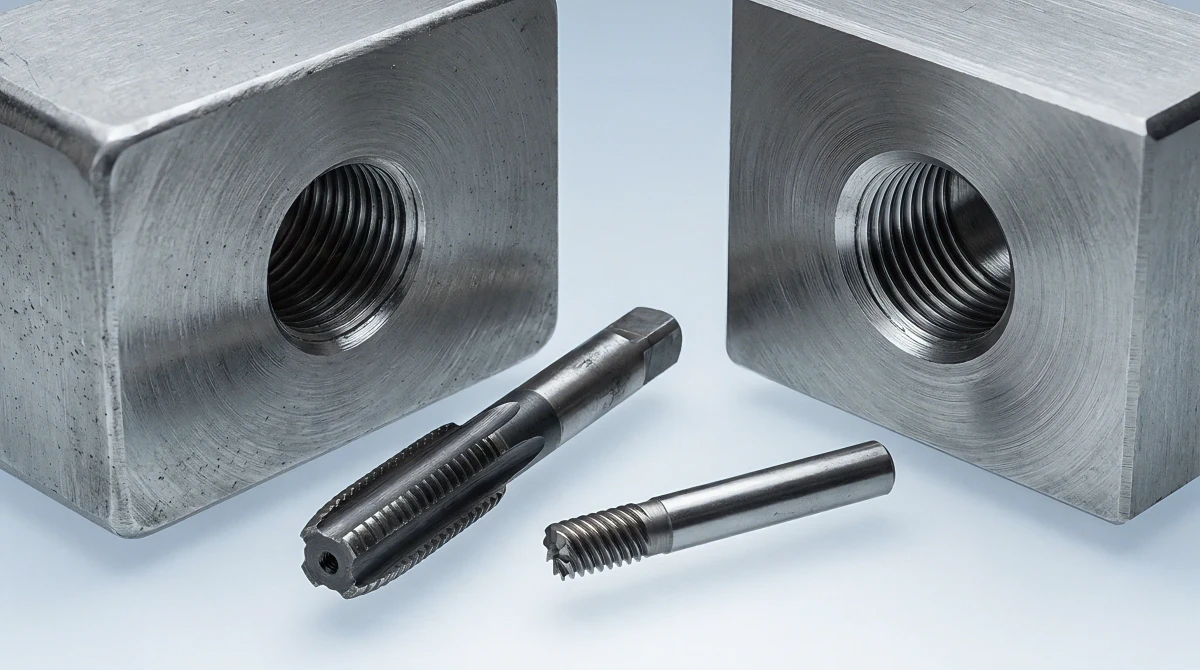
Thread Milling and Tapping Internal Threads in Metal Step by Step

An internal thread is decided at the drill, so gauge the minor diameter, size the drill to the engagement, then tap or mill with the entry and feed checked.

Tapping or Thread Milling for an Internal ThreadBoth methods start from the same drilled hole and end at the same gauge, and they differ in how the thread form gets into the wall. A tap cuts or forms the whole thread in one axial stroke, its size fixed by the tool.

Machining C36000 Free-Cutting Brass for Turned Parts

C36000 cuts so freely that spindle speed, chip control and finish usually set the cycle, so name the temper, the specification and any later joining on the order.

What Makes C36000 the Reference Brass for Turned PartsC36000 is a leaded copper-zinc alloy built to be cut. The Copper Development Association's data page gives its composition as 60.0 to 63.0 % copper, 2.5 to 3.0 % lead, iron at 0.35 % maximum and zinc as the remainder, with copper plus the named elements at 99.5 % minimum.

ISO 965 6H Tolerance for Tapped Holes in Machined Metal

A 6H tapped hole has a band measured in hundredths of a millimeter, and a coating can use up most of it before the part is checked.

What 6H Means on a DrawingISO 965-1 sets the system for ISO general purpose metric screw threads. A tolerance class is written as a figure for the tolerance grade followed by a letter for the tolerance position, a capital letter for an internal thread and a small letter for an external one.

Machining 303 and 316 Stainless Steel

Stainless grade choice for a machined part is a trade between how freely it cuts and how well it resists the environment it works in.

Choosing 303 or 316 for a Machined Stainless PartThe choice sits on one trade. 303 is the free-machining modification of the basic 18 % chromium, 8 % nickel stainless, and it is produced to cut well.

Request a Metal CNC Quote

Send the 2D drawing and the 3D file, with the quantity and the stage of the project. An engineer replies within 1 working day.

The quote form, the mutual NDA and the private folder for your files are on Protolis Atelier, with Metal CNC chosen.

Request a Quote