Specification

A specification is the published document a material, a process or a test is bought to, with the limits a supplier has to meet.

Every Specification article of the Metal CNC Resources, newest first, each written from published standards, research and makers’ data.

Meaning

A specification is the published document a material, a process or a test is bought to, with the limits a supplier has to meet. It turns a name on a drawing into numbers a certificate can be checked against. A data sheet describes a material, and a specification binds it. The drawing and the purchase order name the specification, its edition and any choice it leaves open.

Typical and Minimum

ASM labels its aluminum figures as typical and not for design. A design calculation therefore takes its minimum values from the specification the material is bought to. For 316 plate under ASTM A240, the minimums are 517 MPa (75 ksi) tensile and 207 MPa (30 ksi) yield. Cleveland-Cliffs’ typical room-temperature values for 316 sheet are 627 MPa (91 ksi) and 290 MPa (42 ksi). ATI states that its titanium data should not be construed as maximum or minimum values for specification.
Read More

Material Documents

Grade 303 stainless is sold under ASTM A582, A314 and A484 and AMS 5640. Grade 316 is sold under ASTM A240 for plate and sheet, A276 for bar, and A312 and A479. Ti-6Al-4V Grade 5 bar is sold to ASTM B348. AMS 4928 covers annealed titanium bar, AMS 4965 aged bar and AMS 4911 plate. A part cut from bar quotes the bar specification, and a plate-cut part quotes the plate one.

Process Documents

ASTM A967 makes no recommendation on whether any grade, treatment or acceptance criterion suits an application. Its appendix X1 gives nonmandatory guidance by grade. MIL-A-8625 lets the supplier choose the process conditions unless the drawing says otherwise. In both, the open choices are closed by words on the order.

Edition

Specifications change between editions, and the letters of tests can change with them. MIL-A-8625’s own acquisition list asks for the title, number and date of the specification. A first article report records material and process specifications with their revision levels on Form 2.

Certificates and Documents That Ship With a Machined Metal Lot

Each document proves something different, so the order names the certificate type, the traceability, the process reports and the inspection data it expects.

The Documents That Travel With a Machined Metal LotA lot of machined metal parts usually travels with four kinds of paper, each issued by a different party and each proving something different. Confusing them is the most common reason a file looks complete and is not.
Position Tolerance of Machined Hole Patterns Under ISO 1101 and ASME Y14.5

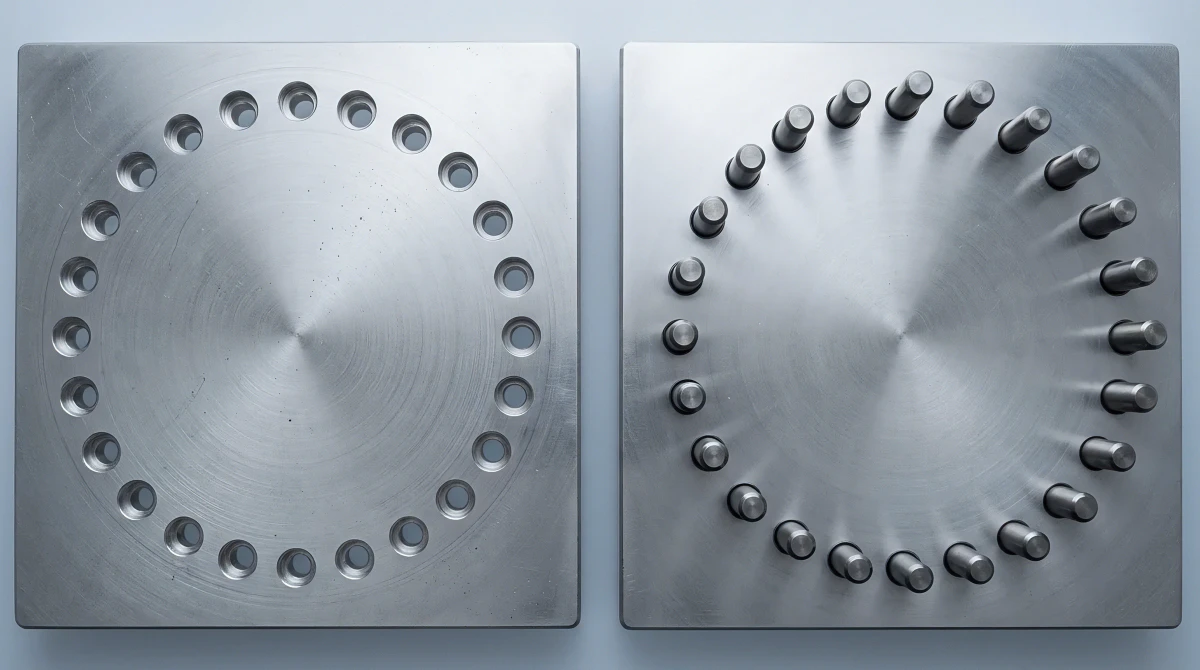
A position frame sets a round zone around exact locations from datums, and its material modifier decides whether that zone grows as the holes grow.

What a Position Tolerance on a Hole Pattern ControlsA position tolerance limits where the axis of a hole may lie. PTC's glossary of model-based definition terms, which sets the ASME and ISO wording side by side, defines it as a zone within which the center, axis or center plane of a feature of size may vary from a true, theoretically exact position.

ISO 1302 and ASME Y14.36 Surface Texture Symbols on a Machined Part Drawing

A surface symbol is read against the edition it cites, and its parameter suffix, lay mark and empty positions decide how the face is cut and inspected.

Which Standard Governs a Surface Texture Symbol TodayThe ISO symbol on most drawings in circulation was drawn to ISO 1302:2002, and that edition is now withdrawn. ISO's own catalogue page lists ISO 1302:2002 as withdrawn and names ISO 21920-1:2021 as the new version.

ASTM B117 Salt Spray Testing of Anodized and Plated Machined Parts

B117 sets the fog but not the hours, specimens or pass mark, so the order has to name the coating specification, the rating method and what was tested.

What ASTM B117 Controls and What It Leaves to the OrderASTM B117 is a practice for operating an apparatus. Its scope covers the equipment, the procedure and the conditions needed to create and keep a salt fog environment, and the apparatus it describes sits in an appendix.

Machining C36000 Free-Cutting Brass for Turned Parts

C36000 cuts so freely that spindle speed, chip control and finish usually set the cycle, so name the temper, the specification and any later joining on the order.

What Makes C36000 the Reference Brass for Turned PartsC36000 is a leaded copper-zinc alloy built to be cut. The Copper Development Association's data page gives its composition as 60.0 to 63.0 % copper, 2.5 to 3.0 % lead, iron at 0.35 % maximum and zinc as the remainder, with copper plus the named elements at 99.5 % minimum.

First Article Inspection Before a Machined Metal Run

A machined run ships only after its first article report is approved, so plan the first delivery around the report and not around the last part off the machine.

What a First Article Inspection Does Before a Run ShipsLockheed Martin UK's guidebook gives the purpose in three lines. A first article inspection provides objective evidence that all engineering, design, contractual and specification requirements are correctly understood, accounted for, verified and recorded.

MIL-A-8625 Anodizing Types and Classes for Machined Aluminum

MIL-A-8625 names the bath, color state, weight or thickness and sealing of an anodized coating, and each choice moves the size of a machined part.

What MIL-A-8625 Covers and What the Types MeanRevision F covers six types and two classes of electrolytically formed anodic coatings on aluminum and aluminum alloys for non-architectural uses. The types differ by the bath and the weight of the coating: Type I is conventional chromic acid anodizing, Type IB a low-voltage chromic acid process, Type IC a non-chromic acid process offered as a non-chromate alternative, Type II conventional sulfuric acid anodizing, Type IIB a thin sulfuric acid process that is also a non-chromate alternative, and Type III the hard anodic coating.

ASTM A967 Passivation for Machined Stainless Steel Parts

ASTM A967 names the baths and the lot tests for passivated stainless parts, and the drawing has to name the treatment, test and edition it wants.

What ASTM A967 Covers and What It Does NotASTM A967/A967M covers chemical passivation treatments for stainless steel parts, along with recommendations and precautions for descaling, cleaning and passivating. The abstract names three families of treatment: immersion in a nitric acid solution, immersion in a citric acid solution, and an electrochemical treatment.

Machining Ti-6Al-4V Grade 5 Titanium

Titanium cuts slowly because it holds heat at the tool and flexes under load, and its condition and cleanliness after the cut matter as much as the cutting data.

Ti-6Al-4V Grade 5 as a Machined MaterialGrade 5 is a two-phase alpha plus beta titanium alloy, with aluminum as the alpha stabilizer and vanadium as the beta stabilizer, and ATI calls it the most widely used titanium grade. The ASTM B348 composition limits for bar, printed by voestalpine, are 5.50 to 6.75 % aluminum, 3.50 to 4.50 % vanadium, 0.20 % oxygen at most, 0.40 % iron at most, 0.08 % carbon at most, 0.05 % nitrogen at most, 0.015 % hydrogen at most, and 0.10 % for any other element, 0.40 % in total.

Machining 303 and 316 Stainless Steel

Stainless grade choice for a machined part is a trade between how freely it cuts and how well it resists the environment it works in.

Choosing 303 or 316 for a Machined Stainless PartThe choice sits on one trade. 303 is the free-machining modification of the basic 18 % chromium, 8 % nickel stainless, and it is produced to cut well.

Request a Metal CNC Quote

Send the 2D drawing and the 3D file, with the quantity and the stage of the project. An engineer replies within 1 working day.

The quote form, the mutual NDA and the private folder for your files are on Protolis Atelier, with Metal CNC chosen.

Request a Quote