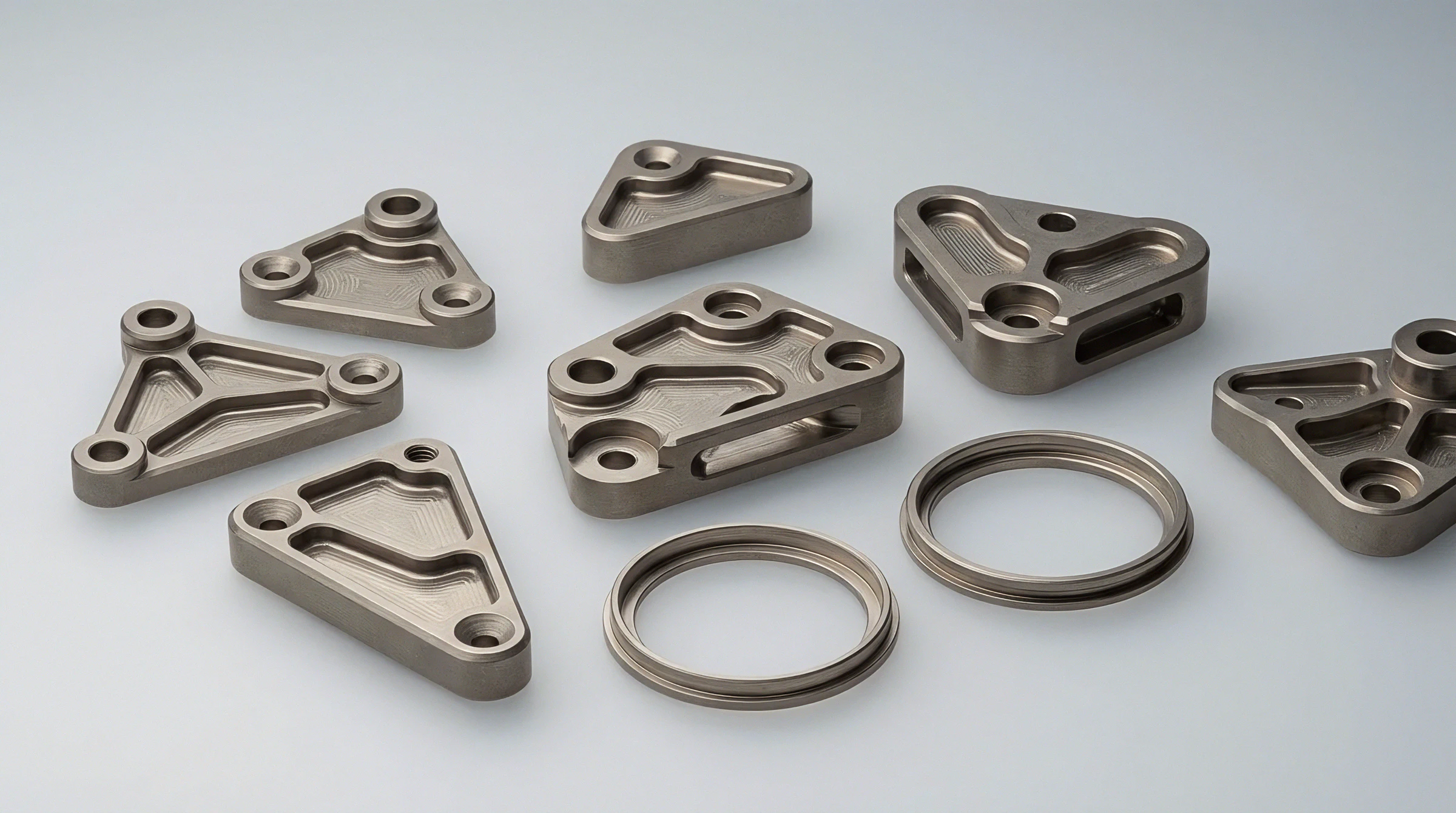
Voestalpine prints a thermal conductivity of 7.1 W/m·K for its Ti-6Al-4V bar. Cleveland-Cliffs prints 16.2 W/m·K for 316 stainless, and ASM 167 W/m·K for 6061-T6 aluminum. Titanium carries heat away from the cut at less than half the rate of the stainless that machinists already treat with care, and at about one twenty-fifth the rate of aluminum, which is why ATI tells shops to machine it like austenitic stainless: slow speeds, heavy feeds, rigid tooling and plenty of cutting fluid.
The slowness is only the visible part of a set of properties that work together. Titanium conducts heat poorly, it flexes more than steel under the same load, it hardens a little when it is aged, and it picks up oxygen and hydrogen from its surroundings when heated. The sheets below, from a mill, a bar producer, a stockholder and a materials data service, give the numbers behind each of those statements and show where they disagree.
Ti-6Al-4V Grade 5 as a Machined Material
Grade 5 is a two-phase alpha plus beta titanium alloy, with aluminum as the alpha stabilizer and vanadium as the beta stabilizer, and ATI calls it the most widely used titanium grade. The ASTM B348 composition limits for bar, printed by voestalpine, are 5.50 to 6.75 % aluminum, 3.50 to 4.50 % vanadium, 0.20 % oxygen at most, 0.40 % iron at most, 0.08 % carbon at most, 0.05 % nitrogen at most, 0.015 % hydrogen at most, and 0.10 % for any other element, 0.40 % in total. Of those limits, the interstitial elements oxygen, nitrogen, carbon and hydrogen are the ones that move strength and ductility when a part is heated in air.
| Property | Value | Source and condition |
|---|---|---|
| Density | 4.47 g/cm³ (0.160 lb/in³) | ATI technical data sheet |
| Density | 4.45 g/cm³ (0.161 lb/in³) | voestalpine |
| Tensile strength, annealed | 900 to 1070 MPa (131 to 155 ksi) | voestalpine |
| Yield strength Rp0.2, annealed | 830 to 1000 MPa (120 to 145 ksi) | voestalpine |
| Elongation at break | 10 % minimum | voestalpine, annealed |
| Hardness, annealed | about 330 HV | voestalpine |
| Hardness, annealed | Rockwell C 30 to 34 | ATI |
| Thermal conductivity | 7.1 W/m·K | voestalpine |
| Mean expansion | 8.6 µm/m·°C | voestalpine; ASM, 20 to 100 °C |
| Melting range | 1538 to 1649 °C (2800 to 3000 °F) | ATI |
| Beta transus | 999 ± 14 °C (1830 ± 25 °F) | ATI |
The density figure spans 4.42 to 4.47 g/cm³ across the sources, and the annealed strength spans a range that depends on the product form and the lot. ATI’s own sheet says its data are typical, and that they should not be construed as maximum or minimum values for specification or for final design. That sentence applies to every row of Table 1.
A titanium sheet prints a typical value and a specification prints a minimum. A drawing for a machined part names the specification, because only the minimum is guaranteed.
Service Temperature and Its Limits
Voestalpine puts the practical ceiling for the alloy near 400 °C, stating that it remains mechanically stable up to about that temperature, while ATI says the alloy can serve from cryogenic temperatures to about 427 °C (800 °F). Two makers and two numbers describe one metal, and the lower of them is the one a designer who has no test data takes.
Why Titanium Machines Like Austenitic Stainless
ATI states the machining practice in words: machine Grade 5 with the practices used for austenitic stainless steels, with slow speeds, heavy feeds, rigid tooling and large amounts of non-chlorinated cutting fluid. Zapp adds that machining can be done by conventional methods and that strong spring-back in cold forming comes from the alloy’s low modulus combined with its high strength, which is the same pairing that makes a thin titanium wall push back against a cutter.
The sheet gives no reasons for the instruction. Each phrase of it can be read against a property in Table 1, and that reading makes the instruction easier to remember:
- Slow speeds, because the metal conducts 7.1 W/m·K, so the heat of the cut stays at the edge of the tool.
- Heavy feeds, because a light cut rubs the surface and a deeper one keeps the edge below the layer that has already been worked.
- Rigid tooling, because the alloy’s strength is high and its modulus of 114 GPa lets the setup flex under the same force.
- Large amounts of non-chlorinated fluid, because the coolant carries the heat that the part cannot, and chlorine in it is a hazard for the alloy’s later heat treatment.
Heat That Has Nowhere to Go
Voestalpine prints a thermal conductivity of 7.1 W/m·K for Grade 5. For comparison, 316 stainless is 16.2 W/m·K on the Cleveland-Cliffs bulletin, and 6061-T6 is 167 W/m·K on the ASM sheet. Titanium’s conductivity is therefore 2.3 times lower than 316 and about 24 times lower than 6061. Its mean expansion of 8.6 µm/m·°C on the same sheet is about half that of 316 and a little over a third of 6061’s, so a titanium part grows less with the heat of the cut, while it holds that heat near the tool for longer, which is where the wear goes.
| Metal | Modulus | Thermal conductivity | Mean expansion |
|---|---|---|---|
| Ti-6Al-4V (voestalpine) | not printed on the maker sheets opened | 7.1 W/m·K | 8.6 µm/m·°C |
| 316/316L (Cleveland-Cliffs) | 193 GPa (28.0 × 10⁶ psi) | 16.2 W/m·K at 100 °C | 16.0 µm/m·°C, 0 to 100 °C |
| 303 (Ugitech, Carpenter) | 196 GPa (28.5 × 10⁶ psi) | 15.3 W/m·K at 20 °C | 16.8 to 18.7 µm/m·°C |
| 6061-T6 (ASM) | 68.9 GPa (10,000 ksi) | 167 W/m·K | 23.6 µm/m·°C |
Expansion works in the machinist’s favor here. A 100 mm (3.94 in.) titanium part that warms 20 °C grows 8.6 × 10⁻⁶ × 100 × 20 = 0.017 mm (0.0007 in.), about half the growth of the 316 part and a fifth of the aluminum one. The part that stays dimensionally calm under temperature is also the part that holds its heat locally, so the effect is a part that is hot in the cut and cool a few millimeters away.
Weight, Stiffness and Strength Against the Alternatives
Titanium is often chosen for weight, and the datasheets allow a direct comparison with the other metals in these resources. Dividing modulus by density gives 25.5 GPa per g/cm³ for Ti-6Al-4V (113.8 GPa at 4.47 g/cm³), 25.5 for 6061-T6 (68.9 at 2.70) and 24.9 for 316 (200 at 8.03). The three come out equal within 3 %, so for stiffness per unit of mass the choice makes no difference.
Strength per unit of mass is where they separate. Dividing the typical ultimate tensile strength by density gives about 224 MPa per g/cm³ for Grade 5 at 1,000 MPa, 204 for 7075-T6 at 572 MPa over 2.81, and 115 for 6061-T6. For 316, the A240 minimum of 517 MPa over 8.03 gives 64. Titanium and 7075 are close, and the differences between them are in temperature range, corrosion behavior and the difficulty of cutting, none of which a strength ratio shows. Grade 5 is also one of the alloys most used in additive manufacturing of metal, so a titanium part with internal channels or a lattice that no tool can reach is usually printed near shape and then has its faces and bores finished on the same machines, with the machining notes in this piece applying to those faces.
Annealed, Aged and What Each Condition Means at the Spindle
Grade 5 is supplied annealed, and it can also be solution treated and aged. ATI prints typical hardness as Rockwell C 30 to 34 annealed and about Rockwell C 35 to 39 after solution treatment and aging. Voestalpine prints about 330 HV for its annealed bar. Zapp gives its own figures for the shop furnace: recrystallization annealing at about 730 °C and stress relief annealing at about 500 to 650 °C, in an electrically heated furnace under inert gas or vacuum, or otherwise in an atmosphere adjusted slightly oxidizing to neutral.
| Treatment | Temperature and time | What it is for |
|---|---|---|
| Anneal | 691 to 760 °C (1,275 to 1,400 °F), 0.5 to 2 h, air or furnace cool | the annealed condition used for most bar |
| Stress relief anneal | 538 to 649 °C (1,000 to 1,200 °F), 1 to 8 h | removes machining and forming stress |
| Solution heat treatment | 913 to 954 °C (1,675 to 1,750 °F), 1 h, water quench | first step toward the aged condition |
| Aging | 524 to 552 °C (975 to 1,025 °F), 4 to 8 h, air cool | the aged condition, about Rockwell C 35 to 39 |
Two consequences follow for the order of work. A part that needs the aged strength can be cut before aging, in the softer condition, or after it, in the harder one, and the sheets leave the choice open. For thin walls or tight flatness, a common sequence is to rough the part, relieve it at 538 to 649 °C and then finish it, so that the stress the roughing released does not move the finished surface.
The temperatures in Table 3 sit well below the beta transus of 999 ± 14 °C, which is the line ATI gives between the two-phase structure and the single-phase one. ATI separately lists annealing at 927 to 1,038 °C (1,700 to 1,900 °F) where high hardness, tensile and fatigue strength are wanted, a range that straddles the transus and is a mill treatment, not something a machining shop does to a finished part. The point for a buyer is that the heat treatments a part sees after machining are all below the transus, and none of them is a reset: each leaves the part with whatever contamination its atmosphere gave it.
Section Size and the Aged Condition
ATI adds a limit that is easy to miss. The very best properties in the solution treated and aged condition are obtained in small cross sections that are rapidly quenched, and larger sections, or a delay before the quench, may give lower values than the optimum. A drawing that asks for aged strength in a 60 mm block asks for a number the sheets do not promise.
An aged value on a datasheet belongs to a small section. A large block can come out softer in the middle, and the certificate of the lot is the only place that says by how much.
Grade 5 and Grade 23 ELI
The ELI variant, extra-low interstitial, is Grade 23. Voestalpine and Zapp both list it beside Grade 5 and name medical and surgical implant use as its field. Its lower interstitial limits trade some strength for ductility and fracture toughness, and a drawing that needs ELI names Grade 23 and its specification, because the two grades are not interchangeable on a certificate.
For a machined part, the practical consequences of ELI are a cleaner chemistry to request on the certificate and a somewhat lower strength to design against, and the specific grade for a part is a property of its purpose. Suitability for any regulated use rests with the maker’s declaration and the buyer’s own file, not with the alloy name on a drawing.
Poor Sliding Behavior
A warning sits outside the strength figures. In general practice titanium alloys have poor surface wear behavior and tend to seize in sliding contact with themselves and other metals, and surface treatments such as nitriding and oxidizing are the usual answer. A machined titanium part that rotates or slides against another surface needs that conversation before the drawing is released, since no cutting strategy changes it.
After the Cut, Contamination and Cleaning
ATI’s special precautions describe the risk plainly: Grade 5 can pick up hydrogen during improper pickling, and oxygen, nitrogen and carbon during forging, heat treating and brazing, and the contamination can reduce ductility, with a bad effect on notch sensitivity and forming. For a machined part, the places that matter are the stress relief, the aging and any thermal finish, each of which belongs in a controlled atmosphere. Zapp states that its Grade 5 is best annealed in an electrically heated furnace in an inert gas atmosphere or in a vacuum.
There is a warning on the cleaning side as well. Chlorine salts left on a stressed titanium part that is later heated can start stress corrosion cracking, which is the reason ATI asks for non-chlorinated cutting fluid, and it is a reason to clean a machined part, fingerprints included, before it goes into a furnace.
The bar itself has limits of size and paperwork. Voestalpine lists its Grade 5 portfolio as plates up to 30 mm, bars up to 250 mm, and billets and blocks for forging up to 600 mm, with forged parts and machined components to customer specification, and it supplies inspection certificates to EN 10204 3.1 or 3.2. Zapp lists sheet, plate, bar, wire and forgings, and names the specifications the grade is sold under, from ASTM B348 for bar and B265 for plate and sheet to the AMS numbers used in aerospace and ISO 5832-3 for implants. A part cut from a 300 mm round therefore starts from a forging, not a bar, and its certificate says which.
What to Write on a Titanium Drawing
- The specification and grade, for example Ti-6Al-4V Grade 5 to ASTM B348 for bar, or an AMS number, since the sheets list AMS 4928 for annealed bar, AMS 4965 for solution treated and aged bar, and AMS 4911 and others for plate.
- The condition, annealed or solution treated and aged, with the section size it was treated in.
- Whether stress relief is wanted, with the atmosphere it is to be done in.
- The cutting fluid and cleaning, so that chlorinated products stay out of the work.
- Any sliding contact, so that a surface treatment is part of the design and not a surprise.
For a first part in titanium that is expected to become a few hundred, the decisions above carry through the whole run. A buyer weighing the quantity can read about low-volume metal CNC and about bridge production before fixing the order of heat treatment and finishing.## Sources and Further Reading
- ATI Ti-6Al-4V, Grade 5, Technical Data Sheet, Allegheny Technologies Incorporated, 2012. https://www.atimaterials.com/Products/Documents/datasheets/titanium/alloyed/ati_6-4_tds_en_v1.pdf
- 316/316L Stainless Steel Product Data Bulletin, Cleveland-Cliffs. https://www.clevelandcliffs.com/_assets/_44232ebbf32f67660c1d6a1104d40206/clevelandcliffs/db/1190/10513/file/CLF_ProductData_316-316LSS_052021.pdf
- 303 UGIMA Technical Datasheet, Swiss Steel USA (Ugitech). https://swisssteel-group.com/content-media/documents/Data-Sheets/Swiss-Steel-USA-Canada/Stainless-Steel/303_UGIMA_SSI_Datasheet_24082021_rev_08042021_CH_Reviewed_8.4.21__Revised_8.16.21.pdf
- Titanium Grade 5 (Ti6Al4V), data sheet, voestalpine Specialty Metals. https://www.voestalpine.com/specialtymetals/eu/app/uploads/sites/251/2026/03/Titanium-Grade-5-Ti6Al4V.pdf
- TiAl6V4 (Grade 5) High Performance Alloys Data Sheet, Zapp. https://www.zapp.com/fileadmin/_documents/Downloads/materials/high_performance_alloys/en/TiAl6V4-Grade5-Datasheet.pdf