Read More
Titanium Cycles
ATI prints four cycles for Ti-6Al-4V Grade 5. Annealing runs at 691 to 760 °C (1,275 to 1,400 °F) for 0.5 to 2 hours. Stress relief runs at 538 to 649 °C (1,000 to 1,200 °F) for 1 to 8 hours. Solution treatment runs at 913 to 954 °C (1,675 to 1,750 °F) for 1 hour, with a water quench. Aging at 524 to 552 °C (975 to 1,025 °F) for 4 to 8 hours raises strength and hardness by about 20 %. All of these sit below the beta transus of 999 ± 14 °C (1,830 ± 25 °F). ATI adds that the best aged properties come in small sections quenched without delay. ATI notes that the best aged properties come in small, rapidly quenched sections.Effect on Burrs
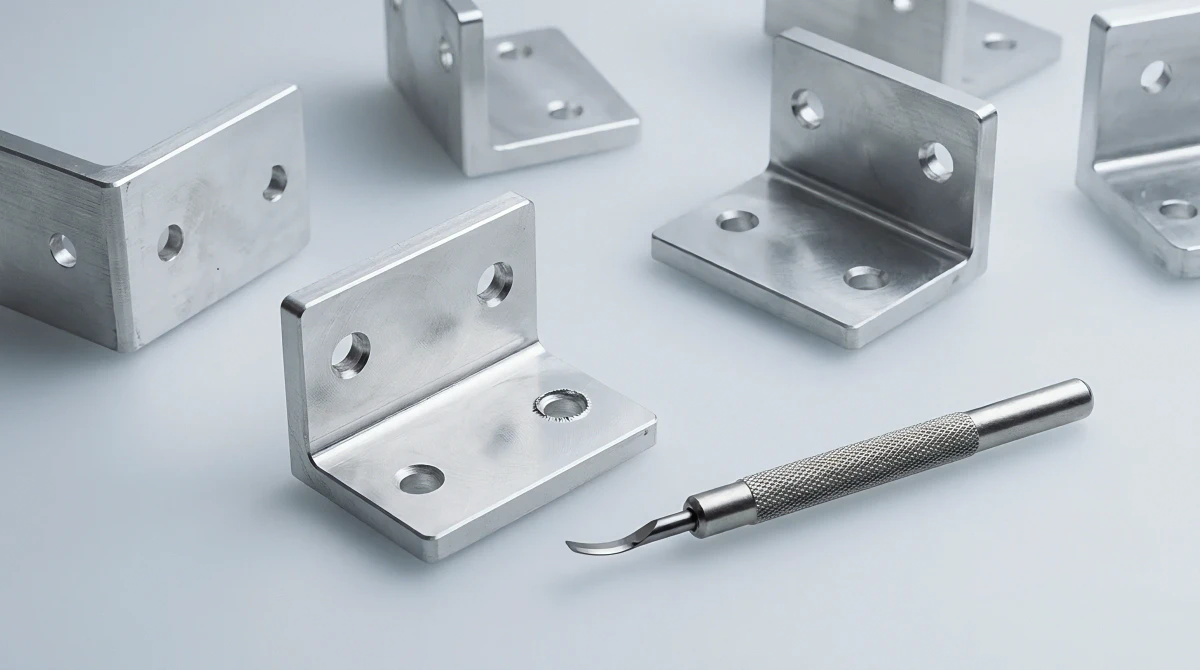
Heat treatment alone can move a burr. In the review’s case study, blocks of cast A356 were drilled in five conditions. The solution treatment was 540 °C (1,004 °F) for 8 hours with a quench into 60 °C (140 °F) water. Three agings of 5 hours followed, at 155, 180 and 220 °C (311, 356 and 428 °F). The peak-aged condition at 155 °C (311 °F), with a hardness of 85 to 90 HRE, gave the smallest burrs. The soft conditions gave the largest.Order of Operations
MIL-A-8625 directs that parts are anodized after all heat treatment, machining, welding and forming are complete. Heat treatable alloys have to be in the required temper, such as T4, T6 or T73, before anodizing. ASTM A967 places descaling ahead of passivation, so scale and tint left by heat treatment come off before the bath. For a thin or flat titanium part, a common sequence is to rough it, relieve it and then finish it. Roughing stress then has no chance to move the finished face.Furnace Atmosphere
ATI warns that Grade 5 picks up oxygen, nitrogen and carbon during heat treating, which can reduce ductility. Zapp states that the alloy is best annealed in an electrically heated furnace under inert gas or in a vacuum. Chlorine salts left on a stressed part can cause stress corrosion cracking once it is heated. A machined part is therefore cleaned, fingerprints included, before it goes into the furnace.Process Record
In a first article inspection, heat treatment belongs on Form 2 with a traceable certificate number. Lockheed Martin UK’s guidebook rejects a report whose special processor the buyer has not approved. A part that leaves the shop for heat treatment therefore depends on a second supplier’s approval status.