Stainless Steel

Stainless steel is a family of chromium and nickel alloyed steels whose corrosion resistance comes from a passive film on a clean surface.

Every Stainless Steel article of the Metal CNC Resources, newest first, each written from published standards, research and makers’ data.

Meaning

Stainless steel is a family of chromium and nickel alloyed steels whose corrosion resistance comes from a passive film on a clean surface. Grades 303 and 316 are austenitic grades of about 17 % chromium with 8 to 14 % nickel. The film forms by itself on a clean face, and passivation helps it form. Machining leaves the face less clean than the grade needs.

Grades

Grade 303 adds at least 0.15 % sulfur and cuts freely, at a cost in corrosion resistance and weldability. Grade 316 adds 2 to 3 % molybdenum, which raises its general corrosion resistance and its resistance to chloride pitting. Cleveland-Cliffs names the paper, petroleum, food and dairy industries among the services where 316 resists most agents. Both carry the same minimum yield and nearly the same density, so strength never decides between them.
Read More

Cutting Behavior

Stainless conducts about 16.3 W/m·K (9.4 Btu/hr·ft·°F), roughly a tenth of 6061-T6. The heat of the cut stays in the tool, the chip and thin sections. Built-up edge, chip material welded to the edge, is common on stainless steel. Notch wear at the depth-of-cut line is common too. The Lund study found tool life models less accurate on its stainless steel, because the previous cut work-hardens the surface.

Surface After Machining

ASTM A967 covers chemical passivation of stainless steel parts by nitric acid, citric acid or an electrochemical treatment. Its purpose is to speed the forming of the passive film on a chemically clean surface. A stainless part leaves the machine with lubricant and iron on its surface, which the cleaning before the bath removes.
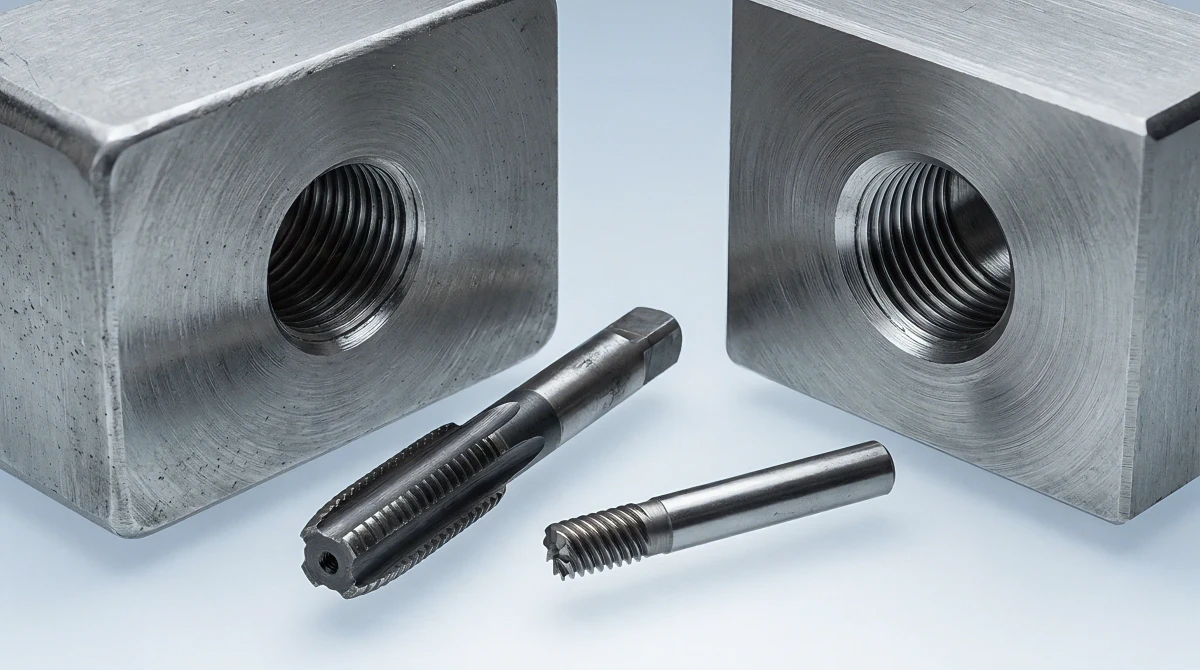
Thread Milling and Tapping Internal Threads in Metal Step by Step

An internal thread is decided at the drill, so gauge the minor diameter, size the drill to the engagement, then tap or mill with the entry and feed checked.

Tapping or Thread Milling for an Internal ThreadBoth methods start from the same drilled hole and end at the same gauge, and they differ in how the thread form gets into the wall. A tap cuts or forms the whole thread in one axial stroke, its size fixed by the tool.

Machining 1045 and 4140 Carbon and Alloy Steel

The hardness and condition on the bar certificate set the speed, depth of cut and power for 1045 and 4140, so put the range on the order.

How 1045 and 4140 Differ Before the First CutThe two grades share a carbon level and little else. FM Carbide's technical reference gives 1045 as a plain medium-carbon steel of 0.43 to 0.50 % carbon and 0.60 to 0.90 % manganese, with phosphorus at 0.04 % and sulfur at 0.05 % maximum, and no deliberate chromium, molybdenum or nickel.

How Many Parts One Cutting Edge Makes in a Machined Run

The parts an edge makes equal its minutes of life divided by the minutes each part spends on it, so a faster cycle can use more edges than it saves.

What Decides How Many Parts a Cutting Edge Can MakeParts per edge is a quotient. The numerator is the tool life, the minutes a cutting edge can stay in contact with the workpiece before it reaches the wear criterion.

ASTM A967 Passivation for Machined Stainless Steel Parts

ASTM A967 names the baths and the lot tests for passivated stainless parts, and the drawing has to name the treatment, test and edition it wants.

What ASTM A967 Covers and What It Does NotASTM A967/A967M covers chemical passivation treatments for stainless steel parts, along with recommendations and precautions for descaling, cleaning and passivating. The abstract names three families of treatment: immersion in a nitric acid solution, immersion in a citric acid solution, and an electrochemical treatment.

Machining 303 and 316 Stainless Steel

Stainless grade choice for a machined part is a trade between how freely it cuts and how well it resists the environment it works in.

Choosing 303 or 316 for a Machined Stainless PartThe choice sits on one trade. 303 is the free-machining modification of the basic 18 % chromium, 8 % nickel stainless, and it is produced to cut well.

Request a Metal CNC Quote

Send the 2D drawing and the 3D file, with the quantity and the stage of the project. An engineer replies within 1 working day.

The quote form, the mutual NDA and the private folder for your files are on Protolis Atelier, with Metal CNC chosen.

Request a Quote