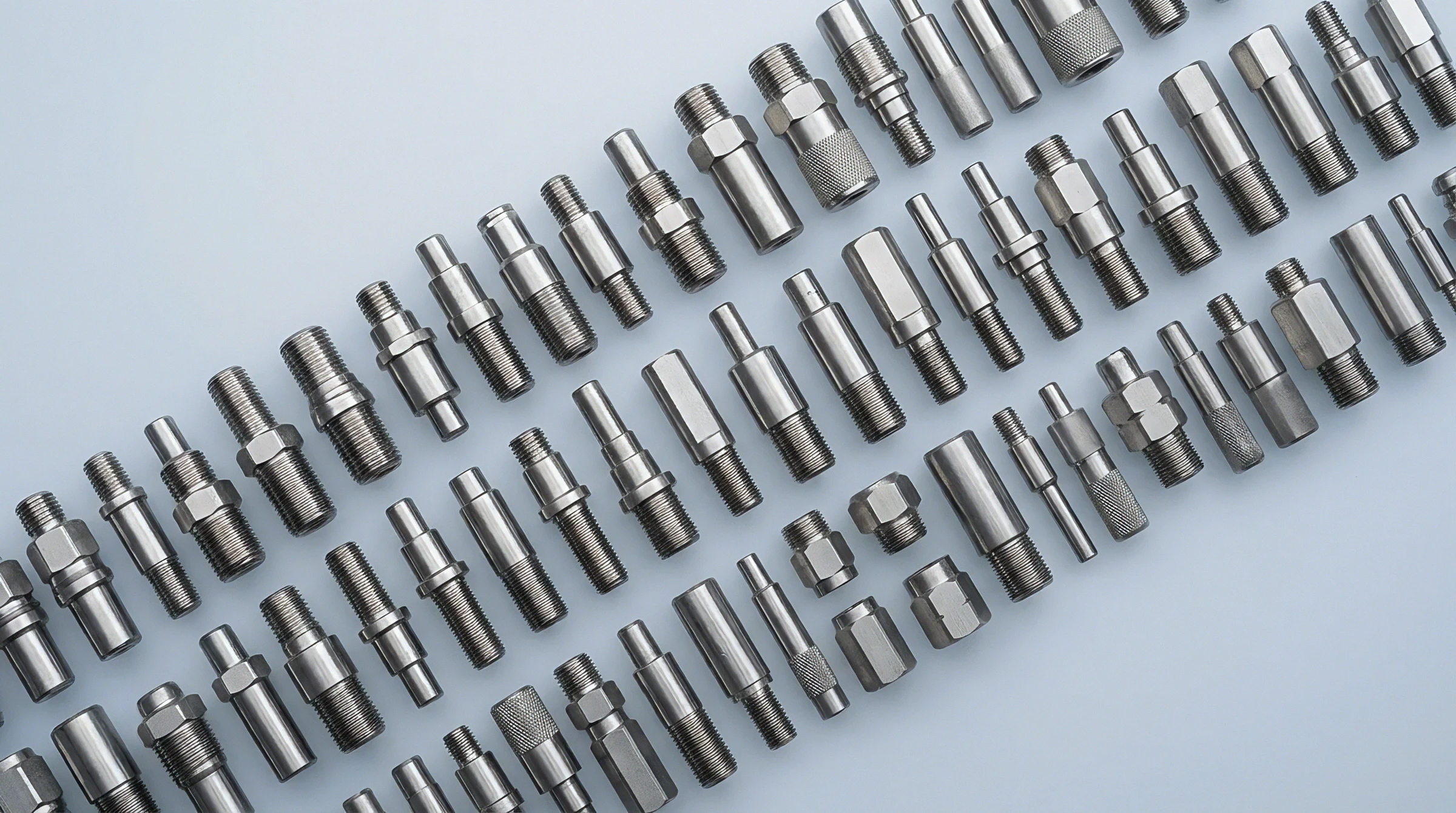
Ugitech, which makes 303 bar under its UGIMA name, prints a tapping speed of 35 to 55 surface feet per minute for the grade with high-speed steel taps, which is 10.7 to 16.8 m/min. The same sheet gives 60 to 105 surface feet per minute, 18.3 to 32.0 m/min, for a 6.35 mm (1/4 in.) high-speed drill in the same bar. The metal is the easiest stainless to cut, and the tap still runs at about half of the drill’s surface speed.
That one pair of figures carries most of what a buyer needs to know about stainless on a CNC machine. Even the grade built to cut freely asks for slow, steady cutting where the tool is buried in the work. The comparison below follows 303 and 316 through their makers’ datasheets: what the added sulfur in 303 does to its corrosion resistance and weldability, what the molybdenum in 316 buys, how both behave in heat, and which numbers belong to a part and which to a mill’s product.
Choosing 303 or 316 for a Machined Stainless Part
The choice sits on one trade. 303 is the free-machining modification of the basic 18 % chromium, 8 % nickel stainless, and it is produced to cut well. 316 is the alloy a designer reaches for when the part meets chlorides, chemicals or washdown, and it carries 2 to 3 % molybdenum to resist them. The British Stainless Steel Association puts the machining side of the trade plainly: austenitic grades such as 304 and 316 are soft and ductile when annealed but undergo extensive work hardening during all forms of machining, and their low thermal conductivity lets heat build up at the cutting tool face.
| Property | 303 (Ugitech 303 UGIMA bar; Carpenter) | 316/316L (Cleveland-Cliffs sheet) |
|---|---|---|
| Chromium | 17.0 to 19.0 % | 16.0 to 18.0 % |
| Nickel | 8.0 to 10.0 % | 10.0 to 14.0 % |
| Molybdenum | 0.6 % max | 2.0 to 3.0 % |
| Sulfur | 0.15 % min | 0.030 % max |
| Carbon | 0.10 % max | 0.08 % max (316), 0.03 % max (316L) |
| Density | 7.9 g/cm³ (0.285 lb/in³); Carpenter 7.83 g/cm³ (0.283 lb/in³) | 8.03 g/cm³ (0.29 lb/in³) |
| Tensile strength | 517 to 861 MPa (75 to 125 ksi), bar over 1 in. | 627 MPa (91 ksi), typical |
| Yield strength, 0.2 % | 206 MPa (30 ksi) minimum, bar over 1 in. | 290 MPa (42 ksi), typical |
| Elongation | 35 % minimum, bar over 1 in. | 55 % in 50 mm (2 in.), typical |
| Hardness | 140 to 223 HB, bar over 1 in.; about 160 HB annealed (Carpenter) | Rockwell B 79, typical |
| Thermal conductivity | 15.3 W/m·K (8.8 Btu/ft·hr·°F) at 20 °C (68 °F) | 16.2 W/m·K (9.4 Btu/ft·hr·°F) at 100 °C (212 °F) |
| Mean expansion | 16.8 µm/m·°C, 20 to 200 °C (Ugitech); 18.7 µm/m·°C (10.4 µin/in·°F, Carpenter) | 16.0 µm/m·°C (8.9 µin/in·°F), 0 to 100 °C |
| Modulus of elasticity | 196 GPa (28.5 × 10⁶ psi) | 193 GPa (28.0 × 10⁶ psi) |
| Melting range | not listed | 1371 to 1399 °C (2500 to 2550 °F) |
The two grades carry nearly the same modulus and density, so stiffness and weight never decide between them. What separates them sits in the first four rows. Sulfur is five times higher in the 303 minimum than in the 316 maximum, and molybdenum is the reverse.
On a drawing, the choice between these two grades is a choice between cutting behavior and corrosion behavior. Stiffness and weight come out the same.
A short check of weight and stiffness completes the picture. A block of 100 cm³ (6.1 in³) weighs about 790 to 803 g (1.74 to 1.77 lb) in 303 or 316, against 270 g (0.60 lb) for 6061-T6 on the ASM density of 2.70 g/cm³. The modulus of 316 at 193 GPa is 2.8 times that of 6061 at 68.9 GPa, and the density is 3.0 times, so a stainless part and an aluminum part of the same shape differ in mass by about the same factor as in stiffness. A part that is stiffness-limited gains nothing in weight by changing the metal.
Where the Same Number Hides a Different Condition
Read the strength rows twice before copying them. The 303 figures are minimums and ranges that Ugitech prints for bar over 1 in. in diameter, and the 316 figures are typical values for annealed sheet, so the two columns are not the same kind of number. Ugitech’s own table shows how much the form matters: its 303 bar under 0.5 in. carries a minimum yield of 45 ksi (310 MPa) and a tensile range of 90 to 125 ksi (620 to 861 MPa), against 30 ksi (206 MPa) and 75 to 125 ksi for bar over 1 in. A drawing names the product specification and form, such as 303 bar to ASTM A582, and the mill certificate gives the tested values for the lot.
What Sulfur Does to 303 and Takes From It
The 0.15 % minimum sulfur in 303 is the reason the grade carries the name free-machining. Carpenter describes its 303 Project 70+ bar as an improved-machining version of the first chrome-nickel free-machining stainless ever produced, and says customers may see average machining speed improvements of 50 % and higher over standard AISI 303. That is a maker’s claim about its own variant, measured by its own method, and it is a statement about bar from one mill.
Ugitech describes its own 303 UGIMA the same way: identical in every way to regular 303 except for machinability, which its steelmaking practice improves by replacing hard, abrasive oxide inclusions with soft ones that help the cut. Its sheet also lists two limits beside the uses: the grade is not recommended for vessels containing liquids or gases at high pressure, nor for extremely thin walls, because of the risk of cracking.
The sulfur is paid for elsewhere in the sheet, and Carpenter prints it. Its 303 corrosion table rates the grade as moderate against nitric, sulfuric, phosphoric and acetic acids, sodium hydroxide and salt spray, restricted in seawater, and excellent only in humidity. It notes that 303 is not recommended for vessels containing gases or liquids under high pressures, and that the alloy is not recommended for welding, because the high sulfur content may cause hot cracking.
- Corrosion, where the table gives a moderate rating in salt spray and a restricted one in seawater, so a part that sees either looks to 316.
- Welding, which Carpenter advises against for 303 and, where it cannot be avoided, hedges with a stringer-bead technique, minimum heat input and AWS E/ER312 consumables.
- Cold working, which 303 withstands only in moderation according to Carpenter, which points to 303Se or 302HQ-FM where a free-machining grade has to be formed.
- Pressure service, which Carpenter excludes for vessels carrying gases or liquids under high pressure.
None of these limits a part that is simply turned or milled and then used dry. Shafts, valve bodies and fittings, which Carpenter lists among typical uses for 303, spend their lives in that condition, and the sheet adds that the grade’s nongalling behavior makes disassembly easy and avoids scratching in moving parts.
What Molybdenum Does for 316
Cleveland-Cliffs writes that 316 and 316L show improved chloride corrosion resistance compared with 304 because of the molybdenum addition, which gives acceptable protection in marine atmospheres where pitting is the concern, and good resistance to most agents used in the paper, petroleum, food and dairy industries, with use in sulfuric acid up to 60 °C (150 °F) at concentrations below 5 %. 316L is the extra-low-carbon variation that avoids harmful carbide precipitation from welding. The bulletin calls the austenitic class generally weldable by the common fusion and resistance methods, with care to form ferrite in the weld deposit against hot cracking, so 316 allows the weld that 303 refuses.
Starting Feeds and Speeds for 303 Bar
Ugitech prints starting values for 303 UGIMA with high-speed and coated carbide tooling, and calls its table a useful guideline for initial set-up. The table below converts the high-speed steel rows to metric. Carpenter’s own 303 sheet adds a caution that applies to every row: its figures are starting points, and each job has to be developed for the best result and tool life, increasing or decreasing speeds and feeds in small steps.
| Operation | Size | Speed | Feed |
|---|---|---|---|
| Turning, depth of cut | 1.0 mm (0.04 in.) | 42.7 to 57.9 m/min (140 to 190 sfpm) | 0.15 to 0.25 mm/rev (0.006 to 0.010 in./rev) |
| Turning, depth of cut | 3.0 mm (0.12 in.) | 30.5 to 45.7 m/min (100 to 150 sfpm) | 0.20 to 0.46 mm/rev (0.008 to 0.018 in./rev) |
| Cut-off, width | 1.0 mm (0.04 in.) | 36.6 to 45.7 m/min (120 to 150 sfpm) | 0.05 to 0.08 mm/rev (0.002 to 0.003 in./rev) |
| Drilling, diameter | 3.2 mm (0.125 in.) | 18.3 to 29.0 m/min (60 to 95 sfpm) | 0.08 to 0.28 mm/rev (0.003 to 0.011 in./rev) |
| Drilling, diameter | 6.35 mm (0.250 in.) | 18.3 to 32.0 m/min (60 to 105 sfpm) | 0.13 to 0.33 mm/rev (0.005 to 0.013 in./rev) |
| Drilling, diameter | 19.05 mm (0.750 in.) | 22.9 to 42.7 m/min (75 to 140 sfpm) | 0.28 to 0.33 mm/rev (0.011 to 0.013 in./rev) |
| Reaming, diameter | 6.35 mm (0.250 in.) | 18.3 to 32.0 m/min (60 to 105 sfpm) | 0.18 to 0.41 mm/rev (0.007 to 0.016 in./rev) |
| Tapping | all | 10.7 to 16.8 m/min (35 to 55 sfpm) | set by pitch |
Two patterns stand out. Speed drops as the cutting edge is buried deeper, from up to 57.9 m/min for a light turning cut to 16.8 m/min at most for a tap, which sits in the hole with its whole length engaged. Feed rises with tool diameter, from 0.08 to 0.28 mm per revolution for the 3.2 mm drill to 0.28 to 0.33 for the 19.05 mm drill. Coated carbide moves the turning rows by a factor of three or more: Ugitech gives 130 to 533 m/min (425 to 1,750 sfpm) for the same 1.0 mm cut.
Why the Tap Runs Slowest
A tap sits buried in the hole with its whole length engaged, and a turning tool takes a clean chip in the open. Carpenter’s sheet states that the alloy increases in strength and hardness on cold work, and the British Stainless Steel Association names work hardening during machining as the trait of the austenitic family. A tool that dwells in the cut or rubs without cutting works the surface it is trying to remove, which is one plausible reason the slowest speed in the table sits on the operation that cuts a thread, though Ugitech gives no reason for the figures.
316 Strength Held at Temperature
Cleveland-Cliffs prints a tensile table for 316/316L at eight temperatures, and it shows how the grade behaves above room temperature.
| Temperature | Ultimate tensile strength | 0.2 % yield strength | Elongation in 50 mm (2 in.) |
|---|---|---|---|
| room temperature | 627 MPa (91 ksi) | 290 MPa (42 ksi) | 55 % |
| 204 °C (400 °F) | 558 MPa (81 ksi) | 241 MPa (35 ksi) | 51 % |
| 316 °C (600 °F) | 538 MPa (78 ksi) | 214 MPa (31 ksi) | 48 % |
| 427 °C (800 °F) | 524 MPa (76 ksi) | 190 MPa (28 ksi) | 47 % |
| 538 °C (1000 °F) | 483 MPa (70 ksi) | 165 MPa (24 ksi) | 44 % |
| 649 °C (1200 °F) | 393 MPa (57 ksi) | 145 MPa (21 ksi) | 40 % |
| 760 °C (1400 °F) | 241 MPa (35 ksi) | 124 MPa (18 ksi) | 37 % |
| 871 °C (1600 °F) | 165 MPa (24 ksi) | 110 MPa (16 ksi) | 44 % |
Between room temperature and 538 °C the typical tensile strength falls by about 23 %, from 627 to 483 MPa, while the yield falls by 43 %, from 290 to 165 MPa. A machined 316 part in a hot process stream keeps its tensile strength better than its yield, and a design that depends on staying elastic reads the yield column. Above that, the bulletin’s stress-rupture table takes over: at 649 °C (1200 °F) the stress for rupture in 1,000 hours is 165 MPa (24 ksi), and in 100,000 hours 94 MPa (13.5 ksi).
The values on a 316 sheet are typical values, so a design check uses the specification minimums for the product form and treats the hot figures as the shape of a curve.
Heat Stays in the Cut, and the Gauge Reads Differently
Thermal conductivity is close on both grades at about 15 to 16 W/m·K, roughly one tenth of the 167 W/m·K printed for 6061-T6 on the ASM sheet. In practice, the heat of the cut stays in the tool and the chip and the thin sections of the part more than it does in aluminum, so a thin wall or a long slender shaft of stainless warms up locally and cools unevenly. Expansion is lower than aluminum at 16.8 µm/m·°C for 303 and 16.0 for 316, yet the figures are far from zero.
Take a 100 mm (3.94 in.) 316 shaft that warms by 20 °C: it grows 16.0 × 10⁻⁶ × 100 × 20 = 0.032 mm (0.0013 in.). A 303 shaft of the same length grows 0.034 mm (0.0013 in.). A tolerance of ±0.02 mm on that length is mostly consumed by the temperature alone, and the shop answers by letting the part reach room temperature before the final check or by finishing in a temperature-controlled room.
What a Machined Stainless Part Needs After the Cut
Carpenter’s note on its 303 sheet is brief and specific: after fabrication of parts, cleaning or passivation should be considered, and for the best corrosion resistance surfaces have to be free of scale, lubricants and foreign particles. Ugitech takes a narrower line for its 303 UGIMA: because of complexity and cost, passivation should be avoided, and where it is required it recommends a 20 to 50 % nitric acid solution for 25 to 40 minutes after alkaline degreasing, followed by thorough rinsing. Both sentences move a stainless part from a machine to a chemical bath, and they are the reason a drawing for a stainless part names the passivation standard it wants and not just the word.
Writing the Grade on the Drawing
A few lines on a drawing prevent most of the questions that arrive later with a quote.
- The grade and its form, for example 303 bar to ASTM A582, or 316L plate to ASTM A240, since the makers list the specifications each grade is sold under (A582, A581, A484 and A314 for 303 with AMS 5640, and A240 with AMS 5524 and 5507 for 316 and 316L sheet).
- Whether welding is intended, since a weld on 303 invites hot cracking and a weld on 316 is made with care for ferrite in the deposit.
- The environment, one line naming chlorides, seawater, acids or only humid air, so that the grade is checked against the service and not the habit.
- The finish after machining, named as a standard, since a stainless part leaves the machine with lubricant and iron on its surface.
- The certificate, a mill certificate tying the lot to the specification, since the typical values in Table 1 are not what the mill guarantees.
Three habits shorten the path from a first part to a repeatable run. Keep the grade the same across prototypes and later lots, because the difference between 303 and 316 shows up in chip behavior, in finish and in corrosion, and none of the three transfers. Hold off on switching from 316 to 303 to save machining time until the environment is confirmed. And record which mill’s bar the first approved part came from, since Carpenter’s Project 70+ and Ugitech’s UGIMA show that two bars both called 303 can machine differently.
A free-machining grade shortens the cycle on the machine and shortens the list of places a part can live. The drawing has to say which of the two matters more.
For buyers moving from a first machined stainless part to a few hundred, the grade choice carries through unchanged, and the pages on low-volume metal CNC and on bridge production describe how such a run is planned.
Sources and Further Reading
- 303 UGIMA Technical Datasheet, revised August 2021, Swiss Steel USA (Ugitech)
- CarTech 303 Project 70+ Stainless, data sheet, Carpenter Technology
- 316/316L Stainless Steel Product Data Bulletin, May 2021, Cleveland-Cliffs
- Influence of steel family (type) on machinability, British Stainless Steel Association
- Aluminum 6061-T6, ASM Material Data Sheet, ASM International