Stiffness

Stiffness is a part's resistance to bending or stretching under load, set by the metal's modulus and, far more, by the part's geometry.

Every Stiffness article of the Metal CNC Resources, newest first, each written from published standards, research and makers’ data.

Meaning

Stiffness is a part’s resistance to bending or stretching under load, set by the metal’s modulus and, far more, by the part’s geometry. A stiff part deflects little under a given force. Changing the metal moves stiffness less than most buyers expect, while changing a depth moves it a great deal.

Geometry First

The deflection of a beam under a given load falls with the cube of its depth. A 6061 rib that must be half as flexible therefore needs about 26 % more depth. Switching the same rib to 7075 buys 4 % less deflection, the equivalent of 1.3 % more depth. A designer who changes alloy to cure a flexing wall spends strength on a problem that depth solves.
Read More

Across Metals

Grade 316 has a modulus of 200 GPa (29 × 10⁶ psi), 2.9 times that of 6061 at 68.9 GPa (10,000 ksi). Its density is 3.0 times higher. A stainless part and an aluminum part of the same shape therefore differ in mass about as much as in stiffness. Ti-6Al-4V lands on the same ratio, within 3 %. A stiffness-limited part gains nothing in weight by changing among these metals.

Effect on Sag

The same ratio explains why thin plates of these metals sag alike. A plate 3 mm (0.12 in.) thick on supports 300 mm (11.8 in.) apart sags 54 µm (0.0021 in.) in 6061. It sags 55 µm (0.0022 in.) in 316 and 54 µm (0.0021 in.) in titanium. Thickness matters far more than the metal: going to 10 mm (0.39 in.) cuts the sag to about 5 µm (0.0002 in.).

Effect in the Cut

Titanium’s modulus of 114 GPa (16.5 × 10⁶ psi) lets a setup flex under the alloy’s high cutting forces. ATI’s call for rigid tooling follows from that.

Roughing and Finishing Passes in CNC Milling From Stock to Final Size

Rough to an even allowance, program the feed for the chip each pass really makes, and finish with a small constant depth so size depends on the tool, not the stock.

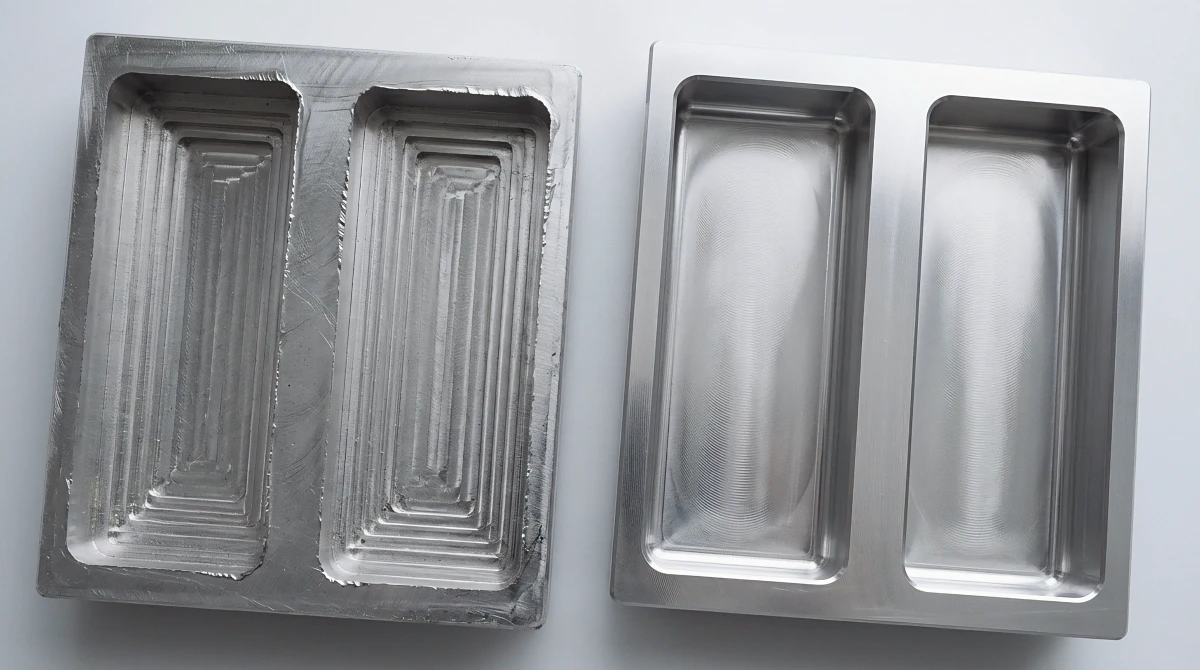
Roughing to Finishing in Milling, Pass by PassA milled part rarely reaches its size in one cut. The material is removed in stages, each with its own job, its own tool and its own engagement, and each leaves the next a predictable amount of stock.
Flatness of Machined Metal Plates

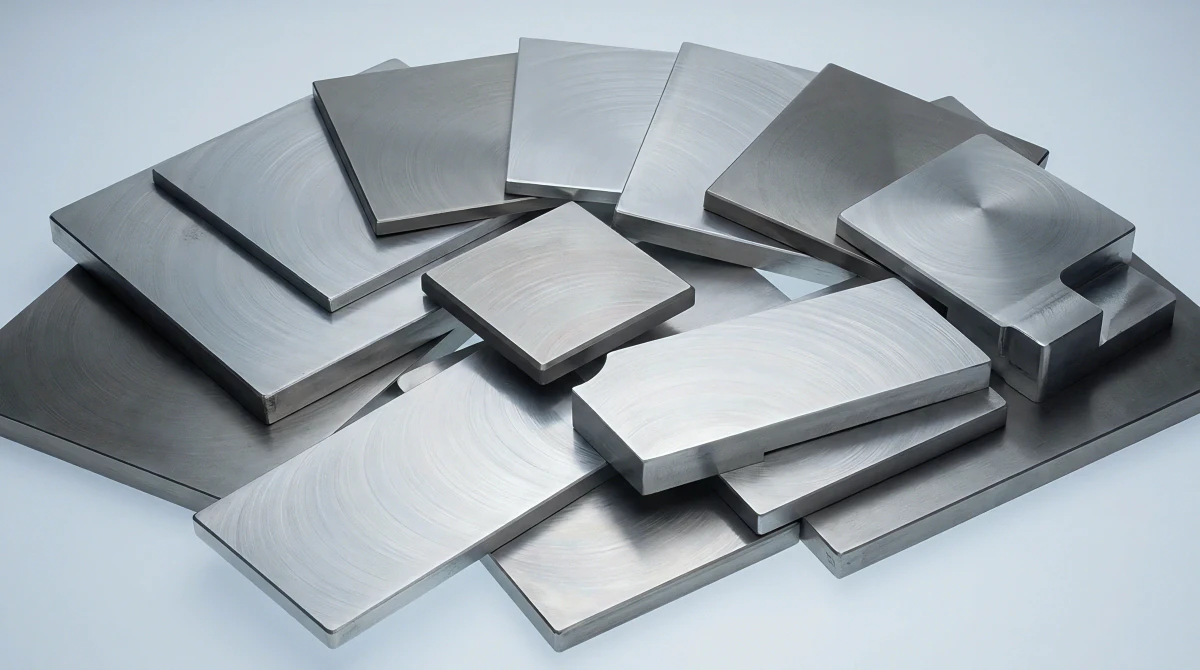
A plate's measured flatness depends on the stress in its stock, its temperature and its support, as well as on the cut that finished it.

What Flatness General Tolerances AllowA machined plate leaves the mill with faces cut flat. Where the drawing gives a face no flatness of its own, ISO 2768-2 sets the tolerance it is held to.

Machining Ti-6Al-4V Grade 5 Titanium

Titanium cuts slowly because it holds heat at the tool and flexes under load, and its condition and cleanliness after the cut matter as much as the cutting data.

Ti-6Al-4V Grade 5 as a Machined MaterialGrade 5 is a two-phase alpha plus beta titanium alloy, with aluminum as the alpha stabilizer and vanadium as the beta stabilizer, and ATI calls it the most widely used titanium grade. The ASTM B348 composition limits for bar, printed by voestalpine, are 5.50 to 6.75 % aluminum, 3.50 to 4.50 % vanadium, 0.20 % oxygen at most, 0.40 % iron at most, 0.08 % carbon at most, 0.05 % nitrogen at most, 0.015 % hydrogen at most, and 0.10 % for any other element, 0.40 % in total.

Machining 303 and 316 Stainless Steel

Stainless grade choice for a machined part is a trade between how freely it cuts and how well it resists the environment it works in.

Choosing 303 or 316 for a Machined Stainless PartThe choice sits on one trade. 303 is the free-machining modification of the basic 18 % chromium, 8 % nickel stainless, and it is produced to cut well.

Request a Metal CNC Quote

Send the 2D drawing and the 3D file, with the quantity and the stage of the project. An engineer replies within 1 working day.

The quote form, the mutual NDA and the private folder for your files are on Protolis Atelier, with Metal CNC chosen.

Request a Quote