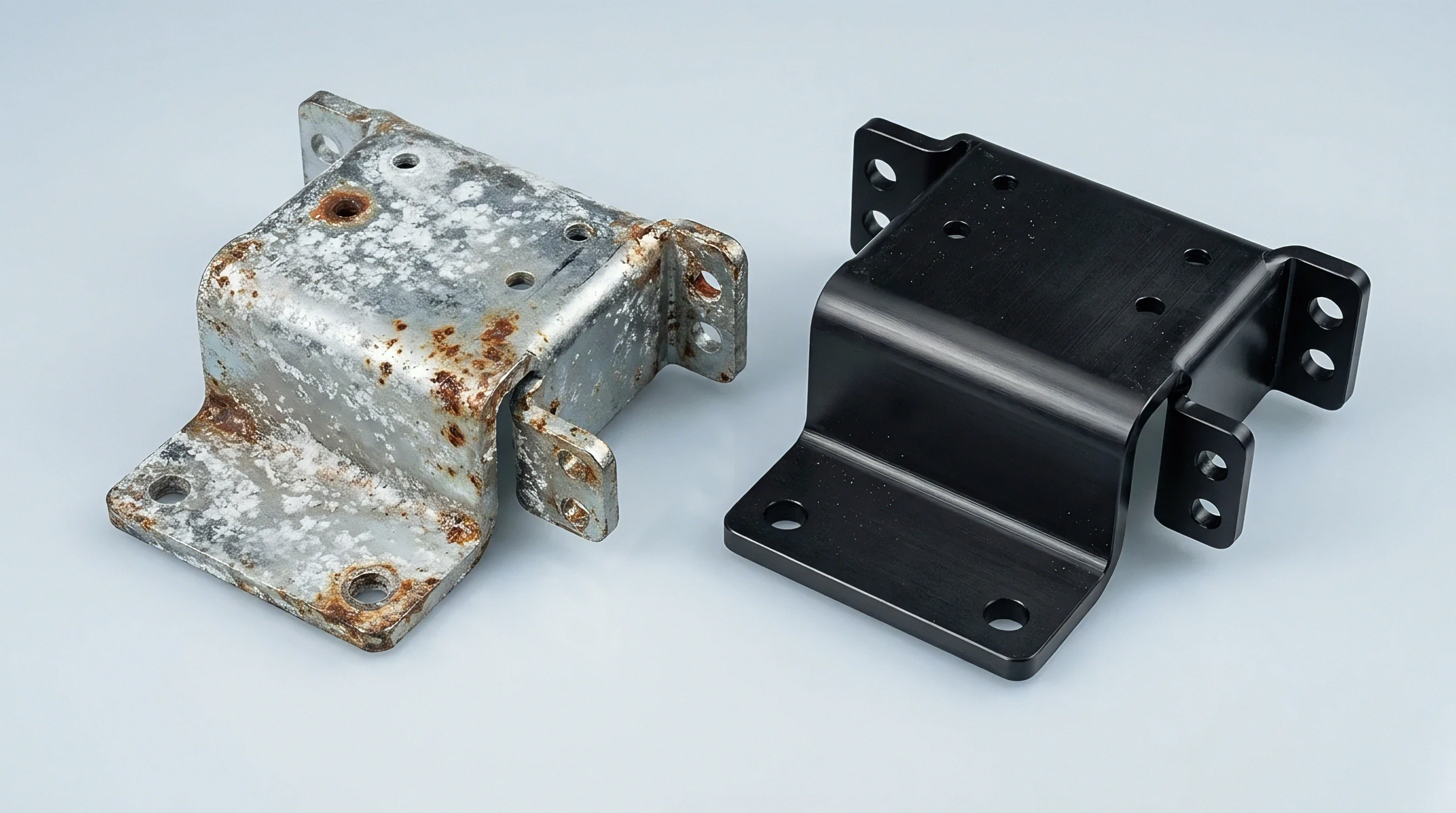
Fourteen days in a fog of 5 % sodium chloride at 35 °C (95 °F), with the significant surface leaning 6 degrees from vertical, and then a count: no more than 15 isolated pits, none wider than 0.79 mm (0.031 in.), across 968 cm² (150 in.²) of test area. That is the acceptance an anodized aluminum part faces under MIL-A-8625F. Almost none of it comes from ASTM B117 itself, and a buyer who writes only “salt spray per B117” on a drawing has ordered a cabinet setting without a result.
What ASTM B117 Controls and What It Leaves to the Order
ASTM B117 is a practice for operating an apparatus. Its scope covers the equipment, the procedure and the conditions needed to create and keep a salt fog environment, and the apparatus it describes sits in an appendix. The same scope then states what the practice does not do: it prescribes no type of test specimen, no exposure period for any product, and no interpretation of the results.
Those three gaps are the whole buying problem. Hours, specimens and a pass mark come from somewhere else, either the specification that covers the coating or an agreement between purchaser and seller, which is how Intertek’s summary of the test describes the exposure period.
ASTM also limits what a result means. The significance clause calls the fog a controlled corrosive environment that has been used to produce relative corrosion resistance information for metals and coated metals in a given chamber. It adds that prediction of performance in natural environments has seldom been correlated with salt spray results used as stand-alone data, and that correlation should be attempted only where long-term atmospheric exposures back it up.
B117 fixes the fog. The coating specification or the purchase order fixes the hours, the specimen and the pass mark, and a drawing note that names only B117 fixes none of them.
Reproducibility gets its own warning. Clause 3.3 of B117-25 says results depend heavily on the specimen type, the evaluation criteria and the control of the operating variables, and that variability has been seen between chambers running nominally the same conditions. Replicates are the practice’s own answer, and they belong in the order.
The ASTM store lists two editions of the practice behind every salt spray test, B117-19 and B117-25, and marks both as historical, which means a later edition has replaced them. A purchase order that names the edition removes one argument before it starts.
Cabinet Conditions Inside a Neutral Salt Fog
The neutral fog is simple to state. Q-Lab, a maker of corrosion test chambers, lists the B117 conditions as a continuous atomized fog at a chamber temperature of 35 °C (95 °F), a 5 % sodium chloride solution held at pH 6.5 to 7.2, and a collection rate of 1 to 2 mL per hour in a funnel 10 cm (4 in.) across. Intertek’s procedure summary adds the support angle: unless a specification says otherwise, the surface of interest leans between 15° and 30° from vertical.
ISO 9227 is the international sibling and offers three fogs instead of one. Its neutral test matches the B117 solution and temperature, while the acetic acid and copper-accelerated variants lower the pH and, in the copper case, raise the temperature.
| Test | Solution | pH | Chamber temperature | Collection in a 10 cm (4 in.) funnel |
|---|---|---|---|---|
| ASTM B117, neutral | 5 % NaCl | 6.5 to 7.2 | 35 °C (95 °F) | 1 to 2 mL/h |
| ISO 9227 NSS, neutral | 5 % NaCl | 6.5 to 7.2 | 35 °C (95 °F) | 1 to 2 mL/h |
| ISO 9227 AASS, acetic acid | 5 % NaCl with acetic acid | 3.1 to 3.3 | 35 °C (95 °F) | 1 to 2 mL/h |
| ISO 9227 CASS, copper accelerated | 5 % NaCl with acetic acid and copper (II) chloride | 3.1 to 3.3 | 50 °C (122 °F) | 1 to 2 mL/h |
The choice between them is not cosmetic. Q-Lab’s ISO 9227 page names the neutral test as the one that suits metals, alloys, metallic and conversion coatings, anodic oxide coatings and organic coatings, and keeps the acid variants for decorative copper, nickel and chromium systems, while noting that they have also proved suitable for anodic and organic coatings on aluminum. An anodized part ordered against MIL-A-8625 sits in the neutral fog, because that specification calls up B117.
Neither the chamber maker nor the standards body sells the fog as a forecast. Q-Lab lists the same weaknesses on both of its pages: the fog does not reproduce humidity swings, temperature cycling, mixed salts or industrial pollutants, it over-weights surface corrosion, and a coating can pass the cabinet and still fail outdoors. Its strength is repeatability, which makes it a quality control test rather than a service-life test.
A neutral fog compares one lot with the next and one process with another. It does not say how many years a bracket will last on a coastline.
Anodized Aluminum Under MIL-A-8625 Salt Spray Acceptance
For anodized aluminum the hours and the pass mark are written out. MIL-A-8625F, the anodic coating specification of 10 September 1993, sends its specimens to a 5 % salt spray in accordance with ASTM B117, with one change to the practice: the significant surface is inclined 6 degrees from vertical rather than the 15° to 30° of an unmodified run. Exposure lasts 336 hours.
The Pit Count and Its Exclusions
Clause 3.7.1.2 sets three conditions, and all of them apply.
| Condition | Pits allowed | Largest pit | Test area |
|---|---|---|---|
| a | 15 isolated pits in total | 0.79 mm (0.031 in.) diameter | 968 cm² (150 in.²) grouped from five or more test pieces |
| b | 5 isolated pits | 0.79 mm (0.031 in.) diameter | 194 cm² (30 in.²) from one or more test pieces |
| c, Types I and IB only | no patchy dark gray areas, spots, streaks or marks | not applicable | the same specimens |
Both counts exclude a band 1.57 mm (0.062 in.) wide around identification markings, edges and electrode contact marks left after processing. The specification defines a pit in 6.19 as a localized corrosion area deeper than it is wide. Note 6.18 explains the dark gray rule for chromic acid coatings: pitting may not be visible to the unaided eye, while dark gray areas after exposure indicate that the coating has degraded.
For a machined part the exclusions matter more than they look. Sharp edges, thread crests and the spot where the rack clamped the part are excluded from the count, so a part that corrodes only at its edges can still meet the clause. A drawing that needs its edges protected says so in its own words.
Which Coatings Face the Fog
Table II of the specification, the process control tests, lists corrosion resistance against Types I, IB, IC, II and IIB, with a minimum of five specimens. Type III hard coat is not on that row. The reason sits in 3.8.2: Type III is left unsealed where wear resistance is the aim, and it is sealed only when the contract or purchase order calls for sealing because the part needs corrosion resistance in exterior, unmaintained service.
Corrosion specimens are dyed (for Class 2) and sealed parts or panels. Class 1 sealing can be done in a 5 % aqueous sodium or potassium dichromate solution at pH 5.0 to 6.0 for 15 minutes at 90 °C to 100 °C (194 °F to 212 °F), in boiling deionized water, in cobalt or nickel acetate, or in other suitable solutions. Note 6.15 observes that a hot deionized water seal on Types I and IB gives good corrosion resistance and may remove the dark gray areas after exposure.
Panels, Months and What a Report Represents
The salt spray result an anodizer reports is usually a process control result. Clause 4.3.3.1 requires the process control tests at least once a month, with no interval longer than 35 days, and at the start of production after a pause of a month or longer. The specimens can be production parts or panels. A corrosion panel is at least 76 mm (3 in.) wide, 254 mm (10 in.) long and 0.81 mm (0.032 in.) thick, in either 2024-T3 or the alloy that made up the largest share of the month’s work.
Clause 4.3.3 says what such a test proves: conformance of the coatings, accepted as evidence of the properties obtained with the anodizer’s equipment and procedures. It is evidence about the line. It is not a test of the parts in a particular box unless the order asks for one.
- A monthly 2024-T3 panel says the tank and the seal were in control that month.
- A panel in the part’s own alloy says more about the alloy, and the specification lets the supplier choose.
- A production part from the lot, run to clause 4.5.3, is the only result that speaks for the lot itself.
Lot acceptance in the same specification runs on sampling. Clause 4.4.2 samples to MIL-STD-105 at inspection level II with acceptance criteria from the contract, and note 6.20 records that earlier revisions used an acceptable quality level of 1.5 % defective. Failure of a process control test stops production under 4.3.4 until the cause is corrected.
Zinc Plated Steel Parts Under ASTM B633
Plated steel follows a different document. ASTM B633-23 covers electrodeposited zinc on iron and steel for corrosion protection, excluding continuous coating of wire and sheet. It offers four standard thickness classes, supplied as plated or with one of five types of supplementary finish, and its abstract lists the properties a lot is checked for: appearance, thickness, adhesion, corrosion resistance and hydrogen embrittlement.
Three lines of the scope affect machined steel directly.
- High-strength steels above a tensile strength of 1700 MPa (247 ksi, 46 HRC) should not be zinc electroplated under this specification.
- Types V and VI were added so that non-chromate passivates can replace hexavalent chromium, a change made to meet RoHS requirements.
- Plating of mechanical fasteners points the purchaser to ASTM F1941/F1941M instead.
The hours a plated part is expected to survive belong to the class and type the order names, and they are written in the specification’s body, which the public store page does not print. A buyer who needs a number on the drawing takes it from the purchased edition of B633 and copies the class, type and hours together. Writing hours without the class and type leaves the plater free to choose a thinner class and argue about the passivate.
For zinc on steel, the thickness class and the supplementary finish type are the order. The salt spray hours only follow from them.
A hardened 4140 shaft or a heat-treated spring clip above 46 HRC sits outside B633 entirely. Its corrosion protection is a separate design choice, and the salt spray question does not arise until that choice is made.
Reading the Panels After Exposure
The fog runs the same for every coating, but the reading does not. Intertek’s summary says results can be judged visually or with ASTM D610, depending on what the client asks for. That choice carries assumptions about the coating that a buyer can check before the parts go in.
| Document | What it rates | Coatings it covers | What its scope leaves out |
|---|---|---|---|
| MIL-A-8625F, 3.7.1.2 | count and size of isolated pits per test area | anodic coatings on aluminum | edge, marking and contact zones within 1.57 mm (0.062 in.) |
| ASTM B537-70 (2019), listed as historical | condition of electroplated test panels | decorative cathodic coatings such as nickel and chromium, or copper, nickel and chromium, on steel or zinc die castings | anodic sacrificial coatings such as zinc and cadmium, and adaptation to production parts |
| ASTM D610-08 (2019), listed as historical | degree of rusting as a percentage, against visual examples | painted steel surfaces | rust creeping from a scribe, score or holiday |
The table shows why “rated per B537” on a zinc-plated part is a category error. B537 states that it is not intended for anodic sacrificial coatings, and its method was built on standard panels of 10 by 15 cm (4 by 6 in.) on outdoor racks, later also used after B117 and other accelerated tests. Its scope also says that the modifications needed to rate real production parts are not covered.
D610 has its own boundary. It estimates the percentage of rust on painted steel from written definitions backed by photographs, and the written definition prevails in a dispute. It does not rate rust spreading from a deliberate scribe.
Anodized parts are rated in the simplest way of the three, by counting. The pit count of MIL-A-8625 is a direct visual examination against fixed numbers, which is why it travels well between laboratories, provided both read the same area and leave out the same edges.
Writing the Salt Spray Requirement Into a Machined Part Order
A salt spray requirement that cannot be argued about later carries six items. Each of them closes one of the gaps that B117 leaves open on purpose.
- Practice and edition, for example ASTM B117-19 or B117-25, and any change to it, such as the 6 degree inclination MIL-A-8625 uses.
- Hours, taken from the coating specification or agreed, written as a number.
- Specimen, either production parts from the lot or panels, with the alloy, size and number of pieces.
- Surface condition, meaning sealed or unsealed, dyed or clear, and for plating the thickness class and finish type.
- Rating method and acceptance, such as the pit count of MIL-A-8625F 3.7.1.2, with the excluded zones named.
- Report, naming the chamber, the start and end times, the specimen identification and the result.
Production parts tell more than panels, but they also bring the machined geometry into the chamber. Threads, blind holes and cross holes hold solution and rinse water, the rack mark sits wherever the part was clamped, and the specification’s edge exclusion removes some of the places where a machined part corrodes first. If those surfaces matter in service, the order names them as areas to be examined rather than leaving them to the default.
For a first lot, the process control panel and the lot test are not interchangeable. The anodizer’s monthly panel speaks for the tank, and a part from the order speaks for the order. Both may be wanted, and they are different lines on a certificate.
A buyer planning parts that will move from a first article to a short run can settle the coating, the specimen and the rating once, before release, and read about low-volume metal CNC and bridge production with that salt spray note already written into the drawing.
Sources and Further Reading
- ASTM B117-25, Standard Practice for Operating Salt Spray (Fog) Apparatus, scope and significance, ASTM International
- ASTM B117-19, Standard Practice for Operating Salt Spray (Fog) Apparatus, product page of the earlier edition, ASTM International
- ASTM B117, Standard Practice for Operating Salt Spray (Fog) Apparatus, test conditions, Q-Lab
- ISO 9227, Corrosion tests in artificial atmospheres, salt spray tests, test parameters, Q-Lab
- ASTM B117, Standard Practice for Operating Salt Spray (Fog) Apparatus, test procedure summary, Intertek
- MIL-A-8625F, Anodic Coatings for Aluminum and Aluminum Alloys, 10 September 1993, US Department of Defense
- ASTM B633-23, Standard Specification for Electrodeposited Coatings of Zinc on Iron and Steel, abstract and scope, ASTM International
- ASTM B537-70 (2019), Standard Practice for Rating of Electroplated Panels Subjected to Atmospheric Exposure, abstract and scope, ASTM International
- ASTM D610-08 (2019), Standard Practice for Evaluating Degree of Rusting on Painted Steel Surfaces, scope, ASTM International