Modulus of Elasticity

The modulus of elasticity is a metal's ratio of stress to strain in the elastic range, the constant that sets how far a part deflects.

Every Modulus of Elasticity article of the Metal CNC Resources, newest first, each written from published standards, research and makers’ data.

Meaning

The modulus of elasticity is a metal’s ratio of stress to strain in the elastic range, the constant that sets how far a part deflects. Geometry multiplies it into a part’s stiffness. Alloys of one base metal share nearly the same modulus, whatever their strength.

Figures

ASM gives 68.9 GPa (10,000 ksi) for 6061-T6 and 71.7 GPa (10,400 ksi) for 7075-T6. Cleveland-Cliffs gives 193 GPa (28.0 × 10⁶ psi) for 316. Neither 303 sheet lists a modulus.
Read More

Relation to Strength

Strength nearly doubles from 6061-T6 to 7075-T6 while the modulus moves by 4 %. A part too flexible in 6061 stays too flexible in 7075. Switching alloy buys the deflection of 1.3 % more depth. Beam deflection falls with the cube of the depth, so a rib about 26 % deeper halves it. Geometry therefore moves stiffness far more than the modulus does.

Relation to Density

The modulus of 316 is 2.9 times that of 6061, and its density is 3.0 times higher. Dividing modulus by density gives figures within 3 % for 6061-T6, Ti-6Al-4V and 316. That is why thin plates of the three metals sag almost alike under their own weight.

Effect at the Machine

ATI asks for rigid tooling for titanium, whose modulus lets the setup flex under the alloy’s cutting forces. The modulus also enters the self-weight sag of a plate, which grows with density and falls with modulus.
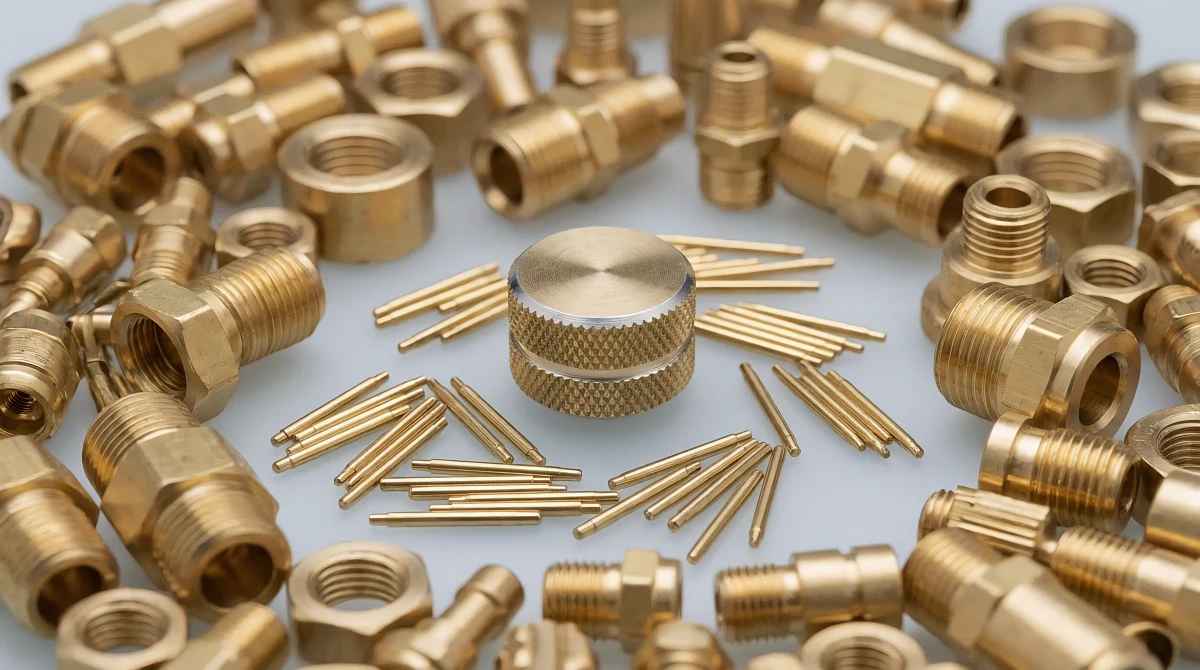
Machining C36000 Free-Cutting Brass for Turned Parts

C36000 cuts so freely that spindle speed, chip control and finish usually set the cycle, so name the temper, the specification and any later joining on the order.

What Makes C36000 the Reference Brass for Turned PartsC36000 is a leaded copper-zinc alloy built to be cut. The Copper Development Association's data page gives its composition as 60.0 to 63.0 % copper, 2.5 to 3.0 % lead, iron at 0.35 % maximum and zinc as the remainder, with copper plus the named elements at 99.5 % minimum.

Machining 303 and 316 Stainless Steel

Stainless grade choice for a machined part is a trade between how freely it cuts and how well it resists the environment it works in.

Choosing 303 or 316 for a Machined Stainless PartThe choice sits on one trade. 303 is the free-machining modification of the basic 18 % chromium, 8 % nickel stainless, and it is produced to cut well.

Request a Metal CNC Quote

Send the 2D drawing and the 3D file, with the quantity and the stage of the project. An engineer replies within 1 working day.

The quote form, the mutual NDA and the private folder for your files are on Protolis Atelier, with Metal CNC chosen.

Request a Quote