Thermal Conductivity

Thermal conductivity is how readily a metal carries heat, deciding whether the heat of the cut spreads into the part or stays at the tool.

Every Thermal Conductivity article of the Metal CNC Resources, newest first, each written from published standards, research and makers’ data.

Meaning

Thermal conductivity is how readily a metal carries heat, deciding whether the heat of the cut spreads into the part or stays at the tool. A metal that conducts poorly is hot at the edge and cool a few millimeters away. That changes the cutting speed a shop can use and how a thin section moves.

Figures

ASM gives 6061-T6 a conductivity of 167 W/m·K (96.5 Btu/hr·ft·°F) and 7075-T6 one of 130 W/m·K (75.1 Btu/hr·ft·°F). Cleveland-Cliffs gives 16.2 W/m·K (9.4 Btu/hr·ft·°F) for 316 at 100 °C (212 °F), and Ugitech 15.3 W/m·K for 303 at 20 °C. Voestalpine gives Ti-6Al-4V 7.1 W/m·K (4.1 Btu/hr·ft·°F), and ASM’s ELI print gives 6.7 W/m·K (3.9 Btu/hr·ft·°F).
Read More

Ratios

Titanium conducts about 2.4 times less than 316 and about 25 times less than 6061-T6. Stainless conducts about a tenth of 6061-T6. The alloy 6061-T6 sheds heat 28 % faster than 7075-T6. A finishing cut on 7075 therefore holds its heat a little longer in a thin section.

Effect in the Cut

ATI asks for slow speeds on Grade 5, because the heat of the cut stays at the edge of the tool. It also asks for plenty of non-chlorinated fluid, which carries the heat the part cannot. In stainless, the heat stays in the tool, the chip and the thin sections more than in aluminum. A thin wall or a slender shaft then warms locally and cools unevenly.

Effect on Size

Low conductivity and low expansion meet in titanium. A titanium part is hot in the cut and cool a few millimeters away. Its expansion of 8.6 µm/m·°C (4.8 µin/in·°F) keeps its size calm meanwhile.

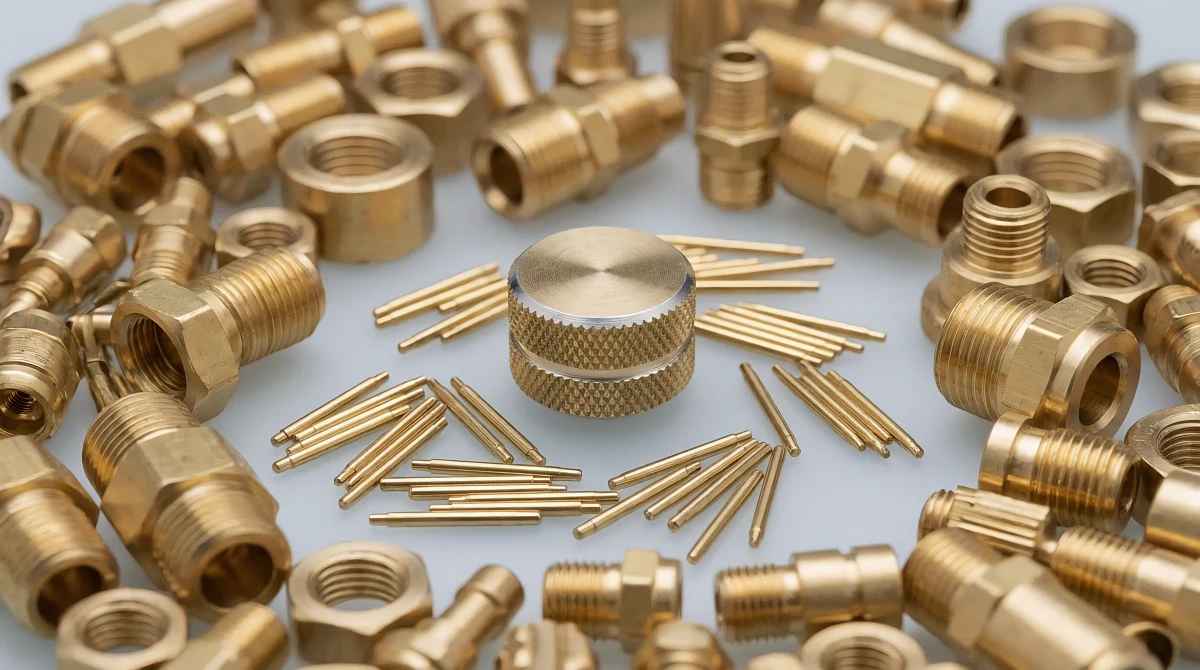
Machining C36000 Free-Cutting Brass for Turned Parts

C36000 cuts so freely that spindle speed, chip control and finish usually set the cycle, so name the temper, the specification and any later joining on the order.

What Makes C36000 the Reference Brass for Turned PartsC36000 is a leaded copper-zinc alloy built to be cut. The Copper Development Association's data page gives its composition as 60.0 to 63.0 % copper, 2.5 to 3.0 % lead, iron at 0.35 % maximum and zinc as the remainder, with copper plus the named elements at 99.5 % minimum.
Machining Ti-6Al-4V Grade 5 Titanium

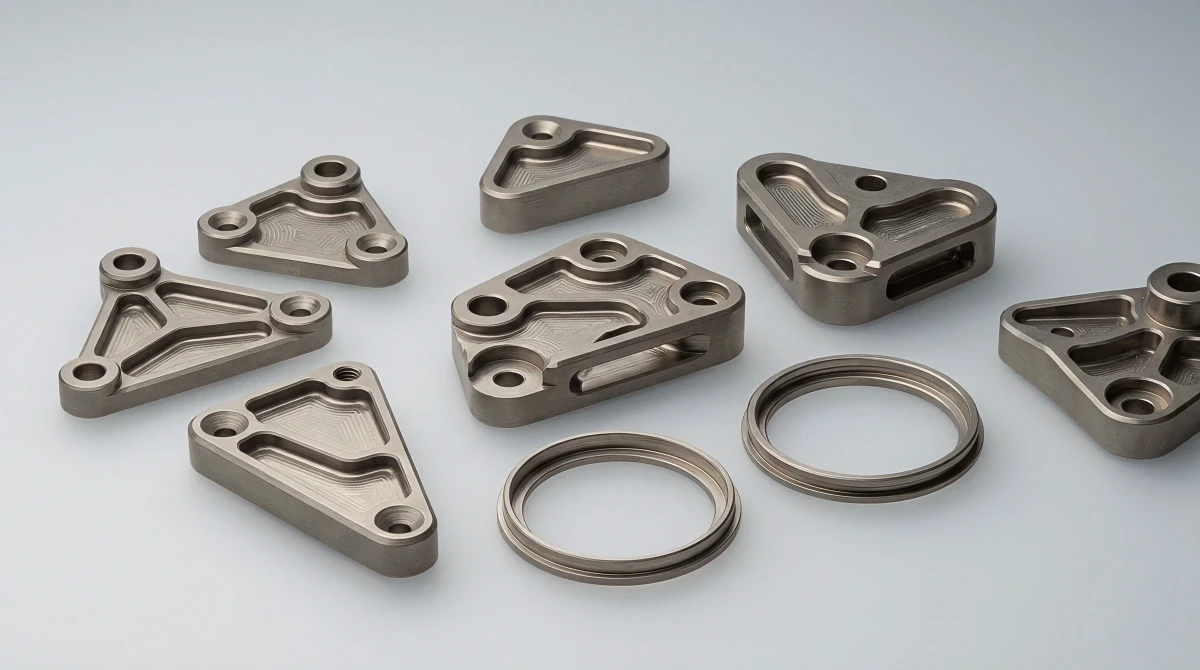
Titanium cuts slowly because it holds heat at the tool and flexes under load, and its condition and cleanliness after the cut matter as much as the cutting data.

Ti-6Al-4V Grade 5 as a Machined MaterialGrade 5 is a two-phase alpha plus beta titanium alloy, with aluminum as the alpha stabilizer and vanadium as the beta stabilizer, and ATI calls it the most widely used titanium grade. The ASTM B348 composition limits for bar, printed by voestalpine, are 5.50 to 6.75 % aluminum, 3.50 to 4.50 % vanadium, 0.20 % oxygen at most, 0.40 % iron at most, 0.08 % carbon at most, 0.05 % nitrogen at most, 0.015 % hydrogen at most, and 0.10 % for any other element, 0.40 % in total.

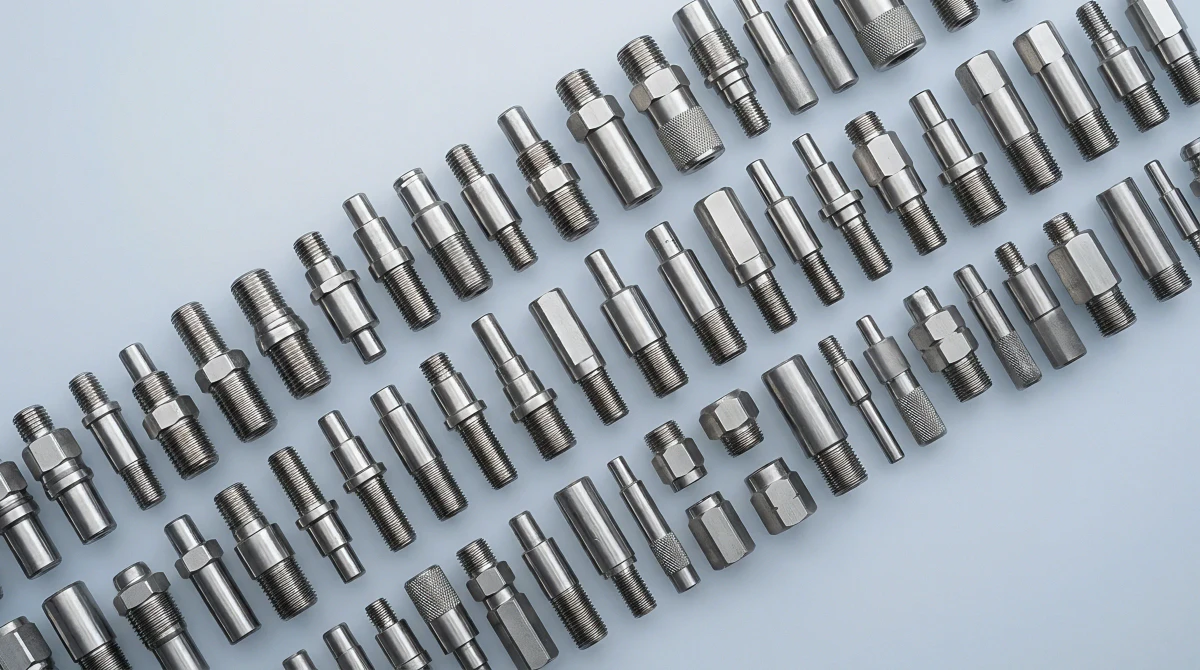
Machining 303 and 316 Stainless Steel

Stainless grade choice for a machined part is a trade between how freely it cuts and how well it resists the environment it works in.

Choosing 303 or 316 for a Machined Stainless PartThe choice sits on one trade. 303 is the free-machining modification of the basic 18 % chromium, 8 % nickel stainless, and it is produced to cut well.

Request a Metal CNC Quote

Send the 2D drawing and the 3D file, with the quantity and the stage of the project. An engineer replies within 1 working day.

The quote form, the mutual NDA and the private folder for your files are on Protolis Atelier, with Metal CNC chosen.

Request a Quote