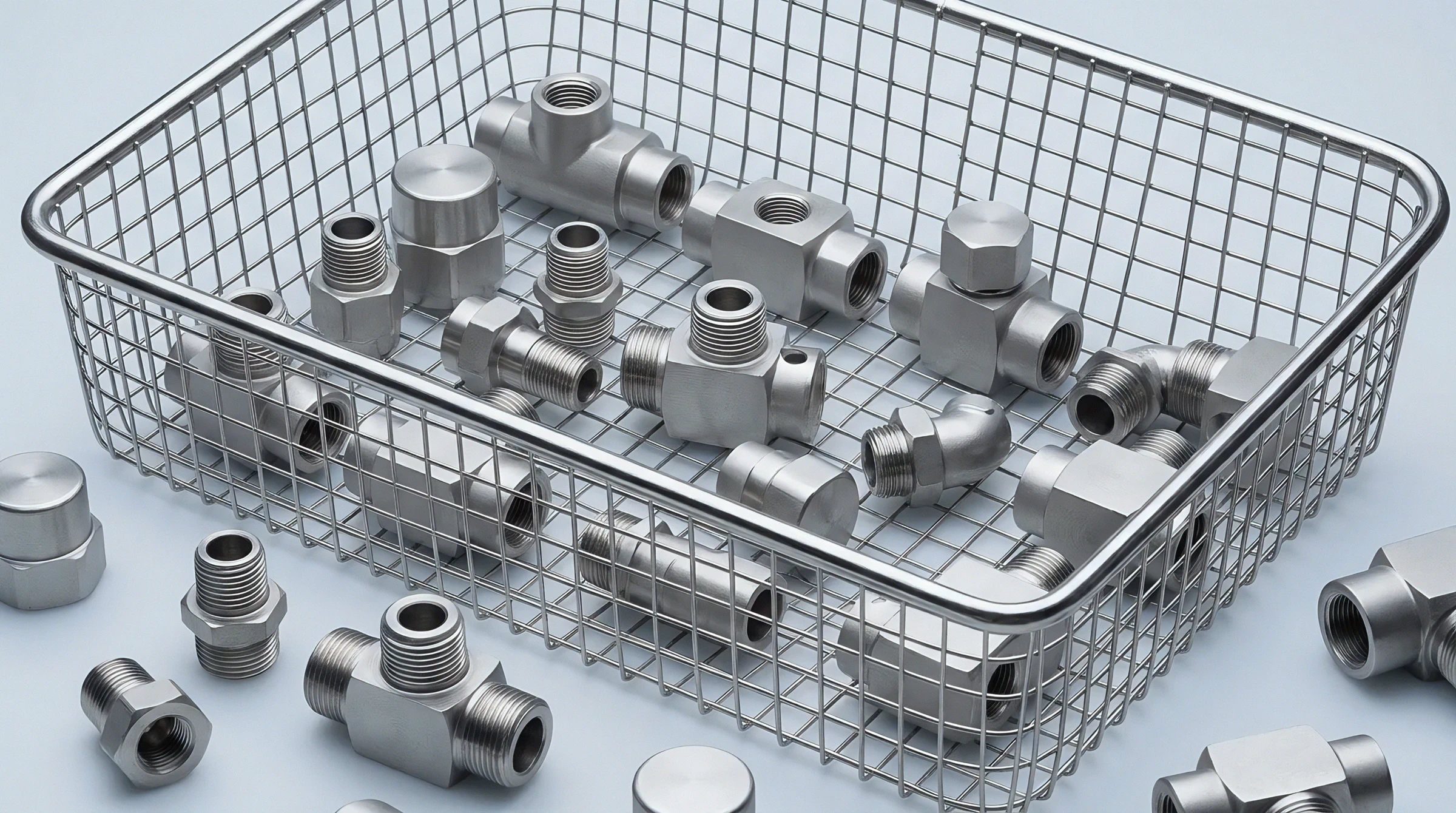
The final rinse after a passivation bath in ASTM A967 carries a limit expressed in parts per million: total solids in the rinse water of 200 ppm at most, which is 200 mg per liter. For a part that has just been cut from bar with a coolant that evaporates to a film, the limit says something about what the standard cares about, and it is not the thickness of anything added to the part. Passivation adds nothing to a surface. It removes what should not be there and lets the metal’s own film form on a clean face.
The standard that governs the practice for stainless steel parts is ASTM A967, and a drawing note that says only “passivate” leaves almost all of it to the supplier. The summary below reads what the public abstracts and a summary of the 2013 revision say about it: the treatments by bath, the tests that follow, what acceptance means in the standard’s own words, and what the text leaves open. The full document is paywalled, and where its figures could not be opened the piece says so.
What ASTM A967 Covers and What It Does Not
ASTM A967/A967M covers chemical passivation treatments for stainless steel parts, along with recommendations and precautions for descaling, cleaning and passivating. The abstract names three families of treatment: immersion in a nitric acid solution, immersion in a citric acid solution, and an electrochemical treatment. Its stated purpose for the chemical treatment is to accelerate the formation of the passive film on a chemically clean surface. Mechanical and chemical cleaning practices are covered in more detail in ASTM A380, which the specification refers to.
What it does not do is equally plain. The abstract says the standard makes no recommendation on whether any grade, treatment or acceptance criterion suits a particular application, and an appendix (X1) gives nonmandatory guidance on selecting a treatment for each grade. SI and inch-pound values are each standard in their own right, and the text says they are not to be mixed. The current edition at the time of writing, as listed by a standards reseller, is A967/A967M-25, issued January 2025, ten pages, from ASTM committee A01.14.
ASTM A967 describes how to clean and passivate stainless steel and how to test the result. It does not say which treatment a grade needs or whether a part will survive its service.
Acceptance in the Standard’s Own Words
The abstract states acceptance for passivated parts as a chemically clean surface with no etching, pitting or frosting on visual inspection. The tests that follow are alternative ways to confirm that contaminant iron and other exogenous matter have been removed, and the reseller’s summary describes them as qualitative. No numeric pass or fail value appears in any of the abstracts or summaries opened for this article.
The Nitric and Citric Treatments in Numbers
The treatments are numbered, and each one fixes a bath, a time and a temperature range. The figures below come from a plating supplier’s summary of the 2013 revision, not from the standard itself, so a buyer who needs a figure for a contract confirms it against the current edition.
| Treatment | Acid and additive | Time | Bath temperature |
|---|---|---|---|
| Nitric 1 | nitric acid 20 to 25 %, with sodium dichromate 2.5 % by weight | 20 min | 49 to 54 °C (120 to 130 °F) |
| Nitric 2 | nitric acid 20 to 45 % | 30 min | 21 to 32 °C (70 to 90 °F) |
| Nitric 3 | nitric acid 20 to 25 % | 20 min | 49 to 60 °C (120 to 140 °F) |
| Nitric 4 | nitric acid, concentration printed unclearly in the summary | 30 min | 49 to 54 °C (120 to 130 °F) |
| Nitric 5 | any combination, with accelerants, inhibitors or proprietary solutions | any | any |
| Citric 1 | citric acid 4 to 10 % by weight | 4 min | 60 to 71 °C (140 to 160 °F) |
| Citric 2 | citric acid 4 to 10 % by weight | 10 min | 49 to 60 °C (120 to 140 °F) |
| Citric 3 | citric acid 4 to 10 % by weight | 20 min | 21 to 49 °C (70 to 120 °F) |
| Citric 4 and 5 | any combination, with accelerants, inhibitors or proprietary solutions | any | any |
Three readings of the table are useful to a buyer. The citric treatments trade time against temperature, from 4 minutes in a bath at 60 to 71 °C to 20 minutes in one that can run at room temperature. The nitric treatments with a fixed recipe run 20 to 30 minutes. And the last treatment in each family is open: Nitric 5 and Citric 4 and 5 may be proprietary, and the summary states that each is valid only if it produces parts that pass the specified test requirements.
Bath Control and Rinsing
The summary gives an immersion bath pH of 1.8 to 2.2 for both families. After the bath, parts are rinsed thoroughly, by stagnant, countercurrent or spray washes, with or without a neutralization step, and the final rinse water has a maximum total solids content of 200 ppm. The abstract says parts are rinsed immediately after leaving the passivating solution, since the rinse stops the chemical reaction.
A shop that passivates with a proprietary solution is allowed to under the open treatments, and it is on the shop’s evidence of passing the tests, not on the recipe, that the part is accepted. A buyer who wants a named recipe, such as Citric 2, has to write it on the drawing.
The Tests Run on Each Lot
The abstract states that each lot of parts is tested with the practices listed in the standard. The lettering has changed between revisions, and two sets are reported here.
| Practice | 2005 edition (ASTM store) | 2025 edition (reseller listing) |
|---|---|---|
| A | water immersion test | water immersion test |
| B | high humidity test | high humidity test |
| C | salt spray test | salt spray test |
| D | copper sulfate test | copper sulfate test |
| E | potassium ferricyanide-nitric acid test | potassium ferricyanide-nitric acid test |
| F | free iron test | damp cloth test |
| G | none listed | boiling water immersion test |
The reseller’s page also mentions a free iron test as a separate item in the 2025 listing, without a method. A purchase order that says “Practice F” therefore means different tests depending on the revision it cites, which is a good reason to name the revision with the practice.
What the Tests Are For
The summaries describe the tests as qualitative and aimed at confirming removal of contaminant iron and other exogenous matter from the surface. They do not say what each one detects in detail, how long it runs or what counts as a pass, and a buyer who needs those values reads them in the standard. In practice the choice of test is a negotiation between the buyer and the shop, since a salt spray test takes longer than a copper sulfate test and a part that has to ship quickly may favor one over another. The standard does not rank them.
Passivation is accepted on a visual check and a qualitative test. Neither one measures how corrosion resistant the part is, and neither is a corrosion rating.
Preparing a Machined Part for the Bath
The standard’s scope includes recommendations and precautions for descaling and cleaning, and a stainless grade’s maker says the same thing from the other side. Carpenter’s data sheet for 303 states that for optimum corrosion resistance, surfaces have to be free of scale, lubricants, foreign particles and coatings applied for drawing and heading, and that after fabrication of parts, cleaning or passivation should be considered. For a machined part, the contaminants are cutting fluid, chips, tool marks, oxide from heat treatment or welding, and anything a fixture left behind.
A typical order of work has four steps, each making the next one valid:
- Remove oil and coolant, since a film on the surface keeps the acid from reaching the metal.
- Remove scale and heat tint, which the standard deals with under descaling and A380 covers in detail.
- Rinse and dry, so the bath is not contaminated by carried-over cleaner.
- Passivate and rinse again to the limit on total solids, then dry and test.
The grade matters here, since not all stainless steels behave alike in an acid bath. Carpenter’s table rates 303 as moderate against nitric acid, sulfuric acid, phosphoric acid and acetic acid, restricted in seawater and excellent only in humidity, which is a reminder that the grade belongs in the conversation about the treatment and its test. Appendix X1 of the standard is where that guidance lives, and it is nonmandatory.
Choosing Between Nitric and Citric in Writing
The table does not say which family is better, and the standard makes no recommendation on suitability. What it does allow is a reading by constraint. The shortest bath in the table lasts 4 minutes (Citric 1, at 60 to 71 °C) and the longest 30 minutes (Nitric 2 and 4), a spread of 7.5 times. The only treatments that run near room temperature are Nitric 2, at 21 to 32 °C with 20 to 45 % acid, and Citric 3, at 21 to 49 °C with 4 to 10 % acid. A shop that cannot heat a tank, or a part that should not sit in a hot bath for long, narrows the field to those two.
The nitric family carries one treatment with sodium dichromate, 2.5 % by weight, in Nitric 1. A buyer whose customer excludes chromates names a treatment from the other rows, and says so on the order. The open treatments, Nitric 5 and Citric 4 and 5, exist for proprietary baths, and they are accepted only on the test result, so a shop that uses one should be able to show the test record for the same grade.
Where Passivation Sits in the Order of Manufacture
The scope of the standard puts descaling and cleaning ahead of the bath, and the abstract requires an immediate rinse after it. For a machined part, that places passivation after the last cut, the deburring and any heat treatment or welding that leaves scale or tint, and before any finish or assembly. A part with blind holes, cross holes or tight crevices holds liquid, and the rinse requirement is the standard’s way of saying that acid left in those places is a defect. Whether a given geometry rinses clean is a question to put to the shop before the first lot, not after it.
Questions to Put to a Shop
- Which treatment from the standard does the bath correspond to, or is it a proprietary one with a test record?
- Which practice is used on each lot, and from which revision of the standard?
- How are blind holes and crevices rinsed, and to what limit on total solids in the final rinse?
- Is the cleaning before the bath done to A380, or by the shop’s own method?
- What does the certificate state: only that the lot passed, or the practice and the result?
Passivation Compared With a Coating
An anodized aluminum part, read under MIL-A-8625, gains a coating whose thickness is specified and whose growth is counted at half the thickness per surface. A passivated stainless part has no such figure, since the treatment is described as accelerating the film’s formation on a clean surface and not as adding a layer. Dimensions for fits and threads are therefore not altered by a coating allowance, though the standard’s text on any removal of metal in the bath was not opened for this article, and a drawing with a very tight tolerance asks the shop to confirm that nothing measurable changes.
The practical difference is one of evidence. An anodizer proves a coating by weight, thickness and salt spray hours. A passivator proves a surface by a test that shows no free iron. A certificate for the first quotes numbers, and a certificate for the second reports a pass.
What a Supplier Signs and What Stays Open
A supplier who accepts a drawing note citing ASTM A967 has agreed to a treatment and to the tests for the lot. The standard leaves open which treatment, which test and which revision, and each of those can be filled with a few words on the drawing or on the order.
| Open point | What A967 says | What the order adds |
|---|---|---|
| Which treatment | several nitric and citric treatments, some proprietary | the named treatment, for example Citric 2, or “supplier’s choice” in writing |
| Which test | each lot is tested by practices in the standard | the practice or practices, with the revision |
| Which revision | letters changed between editions | the year of the edition |
| Which grade | no recommendation for any grade | the grade and form, such as 303 bar or 316L plate |
| Cleaning before | recommendations and precautions in the scope | a reference to A380 where a defined clean is wanted |
| Certificate | not a numeric result | a statement of conformance with the lot number |
A drawing note that carries every row of the table can be short. A plausible one reads: passivate to ASTM A967/A967M-25, treatment Citric 2, test by Practice B on each lot, final rinse to 200 ppm total solids, certificate of conformance with the lot number. Each clause answers one row, and none of them depends on the shop’s habit. A shop that prefers a different treatment says so before the quote, and the change is agreed in writing, since the standard leaves the choice open.
A first machined part in stainless that will grow into a short run keeps one treatment and one test across lots, since a change of either between lots changes the evidence and not necessarily the part. A buyer planning that sequence can read about low-volume metal CNC and about bridge production before fixing the finishing steps.
Sources and Further Reading
- ASTM A967/A967M-25, listing and scope summary, Nimonik standards listing of ASTM International (full text is paywalled). https://standards.nimonik.com/products/astm/a967-a967m/
- ASTM A967-05e2, abstract, ASTM International store. https://store.astm.org/a0967-05e02.html
- ASTM A967/A967M-13, specification summary with treatment parameters, Advanced Plating Technologies. https://advancedplatingtech.com/specification/astm-a967a967m-13/
- CarTech 303 Project 70+ Stainless, data sheet, Carpenter Technology. https://carpentertechnology.com/hubfs/7407324/Material%20Saftey%20Data%20Sheets/303%20Project%2070+.pdf
- MIL-A-8625F, Anodic Coatings for Aluminum and Aluminum Alloys, US Department of Defense. https://www.ibiblio.org/apollo/Documents/assist.dla.mil/MIL_A_8625F.pdf