Cross Hole

A cross hole is a hole drilled across another hole or a bore, so that the two passages meet inside the part.

Every Cross Hole article of the Metal CNC Resources, newest first, each written from published standards, research and makers’ data.

Meaning

A cross hole is a hole drilled across another hole or a bore, so that the two passages meet inside the part. Where they meet, a burr forms that no tool can reach from outside. The intersection also concentrates stress and traps liquid.

Burr Inside

The burr review names a drilled cross hole that breaks into a bore as the case that hurts most. The exit burr forms inside a passage the tool cannot reach again. Exit burrs are larger than entrance burrs and the hardest to remove, which is why most drilling studies measure them. Removing it needs a method that gets into the bore. A buyer asks before the first order whether any hole exits into a bore this way. The answer decides whether deburring needs a brush, a tool in the machine or another method that reaches the passage.
Read More

Stress at the Intersection

A machined part with a sharp internal corner or a cross hole has nowhere to spread a local overload. The alloy 7075-T6 stays at 11 % elongation where 6061-T6 reaches 17 % in bar. The stronger alloy is therefore the less forgiving one at such a feature. Fracture toughness points the same way. The weakest direction of 7075-T6 is a third lower than the single figure ASM gives for 6061-T6.

Rinse

Under ASTM A967, passivated parts are rinsed at once after the bath. Blind holes, cross holes and narrow crevices hold liquid, and acid left there is a defect. Whether a given geometry rinses clean is a question for the shop before the first lot.
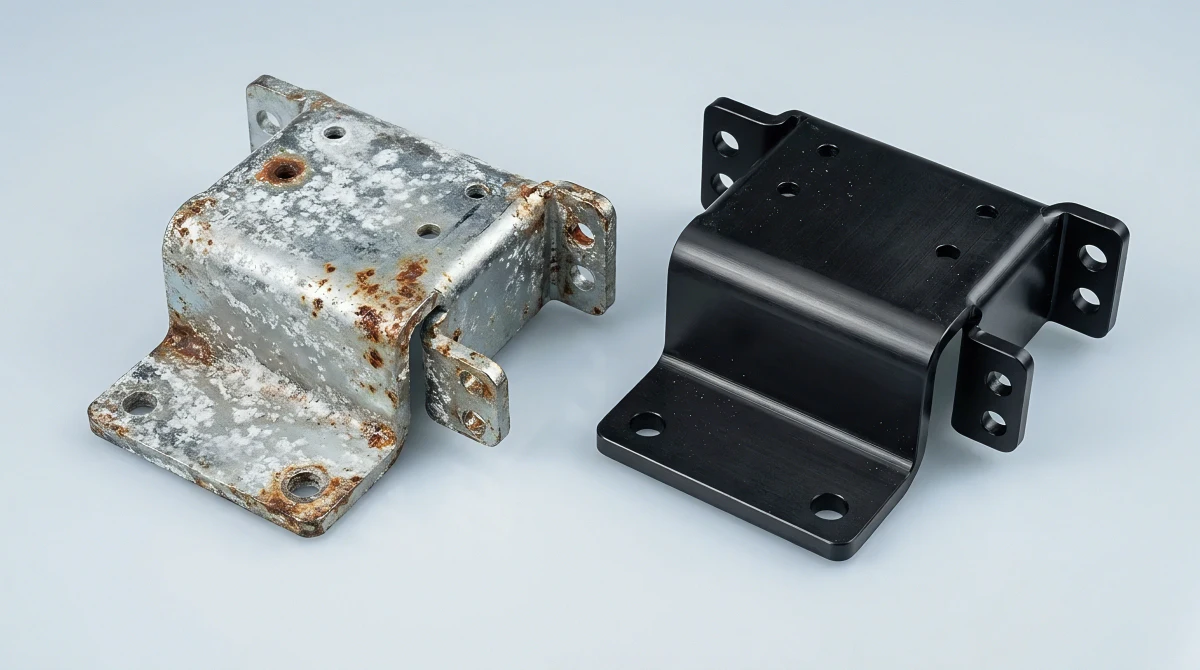
ASTM B117 Salt Spray Testing of Anodized and Plated Machined Parts

B117 sets the fog but not the hours, specimens or pass mark, so the order has to name the coating specification, the rating method and what was tested.

What ASTM B117 Controls and What It Leaves to the OrderASTM B117 is a practice for operating an apparatus. Its scope covers the equipment, the procedure and the conditions needed to create and keep a salt fog environment, and the apparatus it describes sits in an appendix.

How Burrs Form on Machined Aluminum and How They Come Off

A burr is the last chip, so its size follows the alloy, the temper and the tool, and a signed edge size on the drawing turns it into a measurement.

Why a Cutting Tool Leaves a Burr on AluminumA burr is a projection of material beyond the workpiece limits. Its opposite is a negative burr, a missing portion of the edge where material broke away instead of being pushed.

ASTM A967 Passivation for Machined Stainless Steel Parts

ASTM A967 names the baths and the lot tests for passivated stainless parts, and the drawing has to name the treatment, test and edition it wants.

What ASTM A967 Covers and What It Does NotASTM A967/A967M covers chemical passivation treatments for stainless steel parts, along with recommendations and precautions for descaling, cleaning and passivating. The abstract names three families of treatment: immersion in a nitric acid solution, immersion in a citric acid solution, and an electrochemical treatment.

Request a Metal CNC Quote

Send the 2D drawing and the 3D file, with the quantity and the stage of the project. An engineer replies within 1 working day.

The quote form, the mutual NDA and the private folder for your files are on Protolis Atelier, with Metal CNC chosen.

Request a Quote